 Web Development
 APP Development
 CRM Development
 Digital Transformation
 Generative AI
 QA Testing & Automation

Pick any tech forum right now, and you will find the same question showing up constantly. “Should I use Laravel or switch to something else?” People ask it on Reddit, on Quora, in Slack communities. And honestly, the answer has not changed much in years.
Laravel is still the framework most PHP developers reach for when they want to build something serious. Not because it is the newest option. Because it works, and it keeps improving.
I have seen projects where teams switched to Laravel after struggling with CodeIgniter or raw PHP. Within weeks, their development speed doubled. Not because Laravel is magic. Because it removes the friction that slows down every project: inconsistent database handling, messy authentication code, and deployment headaches.
This article covers everything worth knowing about Laravel web development, from what makes the framework genuinely useful to how you actually hire people who know it well.
Laravel Web Application Development Services: The Real Picture
Laravel crossed 2.5 million active websites in 2025. JetBrains’ State of PHP survey confirmed it leads at 64% usage among PHP frameworks. WordPress sits at 25%, Symfony at 23%.
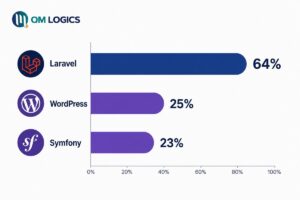
Those numbers matter because they reflect trust built over years in production, not just developer enthusiasm.
The framework follows MVC architecture, which separates application logic from the interface. What that means in practice is that your codebase stays readable as the project grows to 50,000 lines of code. You are not debugging spaghetti.
Everything most applications need ships with Laravel already. Authentication, routing, caching, file storage, queue management, email, and database migrations. Third-party hunting for standard functionality is not the norm here.
Laravel Development Services: Tools Developers Actually Use Daily
Laravel Sanctum Handles API Authentication Without the Complexity
Token-based authentication is something almost every modern application needs. Sanctum does this with minimal setup. You issue tokens, protect routes, and your API is secure. For single-page apps and mobile backends, Sanctum covers what 90% of projects actually require.
Full OAuth2 via Passport is available for cases where third-party token issuance is genuinely needed. Most teams never reach that point.
Laravel Horizon Gives You Visibility Into Background Jobs
Background queues are invisible until something breaks. Then they become very visible and very stressful.
Horizon solves this. It runs alongside your Redis queues and gives you a real-time dashboard showing job throughput, failure rates, and runtime per job type. When a payment processing job fails at 2 AM, you see exactly why when you open Horizon in the morning. No log diving.
Any application handling background work, whether that is emails, file processing, report generation, or anything else, needs Horizon. Running queues without it is genuinely reckless in a production environment.
Laravel Breeze Gets You Past Authentication Scaffolding Fast
Login, registration, password reset, and email verification. These exist in nearly every web application and take a week to build properly from scratch.
Breeze generates all of it in under ten minutes. The code is clean, readable, and built on Tailwind CSS. Teams building MVPs or early-stage products cut setup time significantly by starting here instead of rolling their own.
Spatie Laravel Permission: The Standard for Roles and Access Control
Over 23 million downloads. That number does not happen unless a package actually solves a problem well.
Spatie’s permission package handles roles and permissions with a straightforward API. Assigning a user the Admin role, checking if they have permission to delete a record, and restricting access to specific routes based on role. All of it works with a single method call. Most Laravel applications I have seen in production use this package.

Laravel Collection: Working With Data the Right Way
Collections are what PHP arrays should have been. Over 100 chainable methods for filtering, mapping, transforming, and sorting data. A complex data transformation that takes 30 lines in plain PHP takes 5 lines with Collections.
Anyone processing data inside a Laravel application and writing raw array functions is making more work for themselves than necessary.
Laravel Migration: Version Control for Your Database
Migrations are how Laravel handles database schema changes across environments.
Instead of keeping notes about which SQL scripts to run on which server, you write a migration file. Every developer runs the same command and gets the same schema. Rolling something back takes one command. Schema history is tracked in version control alongside the rest of the codebase.
For teams sharing a codebase, this removes one of the most common sources of conflict and broken environments. It sounds small until you have spent two hours debugging a production issue that turned out to be a missing column.
Laravel Forge and Laravel Cloud: Shipping Without Server Chaos
Laravel Forge Makes Deployment Manageable
Forge provisions servers on AWS(Amazon Web Services), DigitalOcean, and Linode through a dashboard. It configures Nginx, handles SSL certificates, sets up deployment pipelines, and manages environment variables.
Teams that use Forge stop spending hours on server configuration and spend that time on actual product work instead. The tradeoff is straightforward.

Laravel Cloud Takes It Further
Laravel Cloud is the serverless hosting platform built specifically for Laravel. Your application scales with traffic automatically. No manual server provisioning when you hit a spike. No DevOps team required to keep things running.
Taylor Otwell described it plainly: “Laravel Cloud lets developers focus on building applications, not managing servers.”
For startups and agencies serving US clients who want production-grade infrastructure without building a dedicated operations function, the Cloud is worth taking seriously in 2026.
Hire Laravel Web Developers: What Actually Matters When You Evaluate Someone
Most advice on hiring says to check portfolios and ask about communication. True, but not specific enough.
Here is what I actually look at:
- Can they talk through a production problem they solved? Not a tutorial project. A real application where something went wrong, and they fixed it.
- Have they used Horizon in production or just installed it for a side project? There is a difference. Queue management at scale surfaces problems that local environments never show.
- Do they write tests? Developers who treat testing as optional tend to ship applications that work until they do not. Any serious Laravel development agency includes testing in the default workflow, not as an add-on.
- How do they deploy? Experience with Forge or Cloud shows they have shipped real applications. Someone who only develops locally and hands off deployment to someone else is half a developer.
- A live application they can walk you through is worth more than any code sample. Production code reflects real decisions under real constraints.
Laravel Web Developers New York: Why Location Still Matters
Demand for Laravel web developers in New York has grown steadily as SaaS companies and fintech platforms in the US look for teams that understand compliance requirements, US business workflows, and client communication standards.
Time zone alignment is not a small thing. A team operating on a 10-hour offset slows down every decision point in a project.
Working with a Laravel web development agency that has US operations means faster feedback cycles, clearer accountability, and a team that actually understands the regulatory context of what you are building.
At QM Logics, we build Laravel web application development services for US-based businesses. If your project needs a team that has done this before, that is what we do.
Laravel Web Development Company vs. Freelancer
| What You Are Building | Better Fit |
| Quick MVP, isolated feature | Freelance Laravel developer |
| SaaS product with ongoing development | Laravel development agency |
| Enterprise application with compliance needs | Dedicated Laravel web development company |
| Long-term product with scaling requirements | Agency with team structure |
The decision comes down to complexity and continuity. A freelancer works well for defined, contained work. A Laravel development company makes more sense when the project grows, changes, and needs consistent ownership.
Best Practices That Actually Affect Outcomes
Stay on the current version: Laravel 11 brought a cleaner application structure, built-in WebSocket support through Reverb, and improved job batching. Staying on older versions means missing security patches. There is no upside.
Use Domain-Driven Design when the project grows: Organizing code around business logic instead of technical layers keeps larger applications navigable. Start with Laravel Modules. Move to microservices only when actual scaling needs justify it, not as a default starting point.
Cache early: Laravel supports Redis, Memcached, and database caching natively. Applications that cache frequently accessed data handle traffic spikes without collapsing. Those who do not find out the hard way.
Queue everything slowly: Email sending, file processing, report generation, and payment webhooks. None of these belong in a synchronous request cycle. Push them to a queue. Horizon shows you when they fail.
Write tests before you think you need them: The projects that skip tests always pay for it later, usually during a critical deadline. Laravel’s testing tools make this straightforward. There is no good reason to skip it.
Real Example: A US SaaS Platform That Scaled Past 100,000 Users
A project management platform built on Laravel scaled from 5,000 to over 100,000 users within 18 months. Their stack:
- Sanctum for API token authentication
- Horizon with Redis for background jobs
- Spatie permission package for role management
- Forge on AWS for deployment
- Telescope for performance monitoring
The architectural decision that made scaling possible was simple. They built API-first from the beginning. Every feature was an endpoint. When they launched a mobile app a year later, the backend needed zero changes.
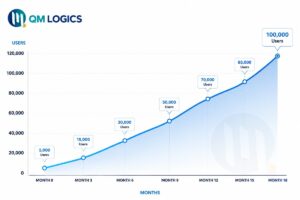
That is what planning ahead looks like in Laravel web application development.
Conclusion
Laravel web development has been the most dependable choice in PHP for over a decade. The ecosystem is mature, the tooling is production-ready, and the developer community is large enough that finding solutions to real problems takes hours, not weeks.
Whether you are building from scratch, looking to hire dedicated Laravel web developers, or need a top Laravel development company that actually delivers, the right expertise is what separates a project that ships from one that stalls.
QM Logics provides Laravel web development services for businesses across the United States. For framework documentation, the official Laravel docs are the reference you want.
Frequently Asked Questions
What is Laravel web development used for?
Laravel is used to build web applications, SaaS platforms, REST APIs, e-commerce systems, and enterprise software. Its MVC architecture, Eloquent ORM, and built-in tooling make it practical for projects ranging from small MVPs to high-traffic production systems.
Is Laravel suitable for large-scale applications?
Yes. Laravel supports queue-based background processing through Horizon, horizontal scaling, microservices architecture, and serverless deployment through Laravel Cloud. Enterprises including Pfizer and Zillow have run Laravel in production at scale.
What is the difference between Laravel Sanctum and Laravel Passport?
Sanctum handles API token authentication and SPA session management. Passport implements the full OAuth2 specification for issuing tokens to third-party applications. Most applications only need Sanctum. A Passport becomes necessary when third-party OAuth flows are a specific requirement.
How long does Laravel web development take?
A basic application with authentication and CRUD operations typically takes two to four weeks. A full SaaS product with custom integrations takes three to six months, depending on scope and team size.
What should I look for in a Laravel web development agency?
Live applications they have shipped in production. Hands-on experience with Sanctum, Horizon, Spatie, and deployment tools like Forge or Cloud. Test coverage in their workflow. Client reviews that mention specific outcomes rather than vague praise.