 Web Development
 APP Development
 CRM Development
 Digital Transformation
 Generative AI
 QA Testing & Automation
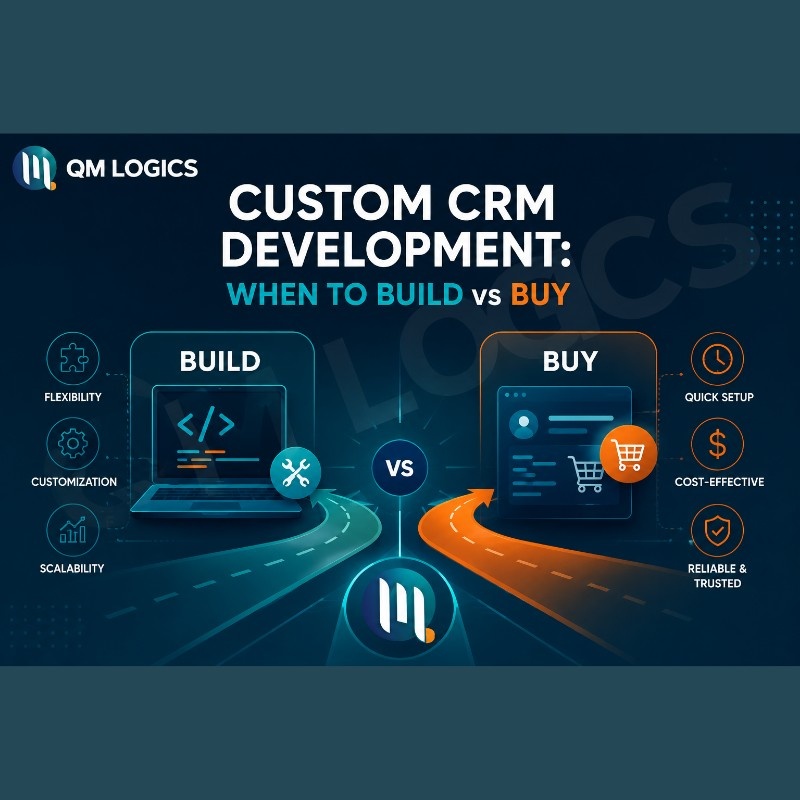
The question I hear most from growing businesses is this: Should we build a custom CRM or just pay for Salesforce? People ask it on Reddit, in B2B communities, and on sales team calls every day. Most of them already sense that generic tools are not working. They just want confirmation.
The global CRM market crossed $80 billion in 2025. It is on track to hit $254 billion by 2032, growing at 12.4% every year. That growth reflects how important customer relationship management software has become across every industry in the United States. But market growth does not tell you what fits your business.
This guide breaks down the real difference between building and buying, which industries get the most out of custom CRM development, and what to look for in a CRM software development company before you commit to anything.
What Is CRM Development and Why Does It Matter?
CRM development is the process of designing and building software that manages how a business handles its customer relationships. It tracks leads, stores interaction history, automates follow-ups, and connects your sales, marketing, and support operations in one place.
Off-the-shelf platforms like Salesforce, HubSpot, and Microsoft Dynamics come pre-built. You subscribe, configure settings, and start using them within days. Custom CRM development works differently. You define the system from scratch, built entirely around how your business actually operates.
The difference sounds simple on paper. In practice, it changes everything about how your team works.
Core Functions of a CRM System
Before deciding on custom CRM development or buying, it helps to understand what a CRM actually does at its core. Most modern CRM solutions handle:
- Lead and contact management
- Sales pipeline stages and deal tracking
- Full communication and interaction history
- Automated task creation and follow-up scheduling
- Analytics dashboards and performance reporting
- Integration with billing, ERP, email, and third-party tools
The CRM database sits at the center of all these functions. Clean, well-structured data is what separates a useful CRM from an expensive contact list.
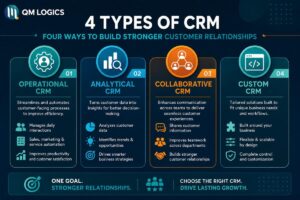
Types of Customer Relationship Management Software
| CRM Type | Primary Use Case | Common Examples |
| Operational CRM | Sales automation, contact workflows | Salesforce, Zoho |
| Analytical CRM | Reporting, data-driven decisions | HubSpot, SAP CRM |
| Collaborative CRM | Team communication, customer service | Dynamics 365, Freshdesk |
| Custom CRM | Unique workflows, industry-specific needs | Built by a dedicated CRM developer |
Custom CRM Development vs Off-the-Shelf CRM Solutions
This comparison comes up constantly in businesses that have scaled past their original setup. Here is a direct breakdown of both paths:
| Factor | Custom CRM Development | Off-the-Shelf CRM |
| Workflow fit | Built exactly for your process | You adapt to the platform |
| Data ownership | Full control | Governed by vendor policy |
| Customization | Unlimited | Limited by platform architecture |
| Integrations | Designed to your specifications | Pre-built or marketplace add-ons |
| Scalability | Built for your specific growth | Tied to the vendor roadmap |
| Monthly dependency | None after build | Per-user subscription, ongoing |
When Custom CRM Development Services Are the Right Choice
Not every business needs custom CRM development. But certain situations push clearly in that direction.
Custom CRM development is the right move when:
- Your sales workflow has unique stages, approvals, or rules that do not fit standard templates
- You operate in a regulated industry like healthcare, real estate, or legal services
- You need one system to handle sales, client portals, and internal reporting together
- You have hit the customization ceiling of platforms like Salesforce or HubSpot
- You want full control over your customer relationship management database and data architecture
- You need a CRM app that works across both web and mobile, with custom business logic
If none of these apply, buying is the faster path. Platforms like Salesforce handle standard pipelines well. For straightforward sales teams, the off-the-shelf route makes sense.
Custom CRM Development Solutions for Key Industries
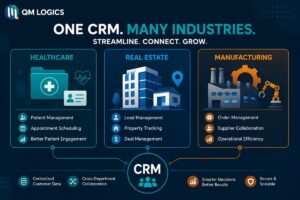
Certain industries consistently run into the limits of generic CRM platforms. Their workflows are too complex, their compliance requirements too strict, or their data models too specific for off-the-shelf tools to handle properly.
A recent industry survey found that 43% of companies say their current CRM system does not meet their specific business needs. For many of them, the solution is not switching platforms. It is building one that actually fits.
Healthcare CRM Software Development
Healthcare CRM software development requires building around compliance rules from day one. HIPAA, protected health information, and patient data security do not fit neatly into generic CRM templates. A custom healthcare CRM manages patient relationship management, referral tracking, appointment history, and secure internal communication inside one system. These features need to be architected in from the start, not added as workarounds later.
One healthcare industry implemented a phased CRM strategy that prioritized high-value, practical features first. The result was 93% user adoption, which is exceptionally high for healthcare software. That kind of result comes from building around how clinical teams actually work, not from forcing them to adapt to a template.
CRM for Property Developers and Real Estate
Custom real estate CRM software development connects property listings, buyer profiles, deal milestones, commission tracking, and legal timelines in one place. CRM for property developers needs to link the sales team, legal department, and marketing operations without needing three separate systems.
I came across a US-based real estate company using Salesforce for sales and a separate platform for contract documents. The two never synced properly. Their team spent hours each week fixing data discrepancies between systems. A custom CRM development solution consolidated both into one platform. Manual entry errors stopped. Deal visibility became real-time. Their managers finally had one source of truth.
Customer Relationship Management in Manufacturing and B2B
Customer relationship management system in manufacturing goes well beyond tracking sales. It involves supply chain communication, multi-party account management, production-linked quoting, and complex pricing models that standard CRMs do not support natively.
According to industry research, custom CRM development companies are building manufacturing systems with ERP integration for real-time inventory visibility, production scheduling, and quote-to-cash automation. This is functionality that no off-the-shelf platform provides without heavy third-party customization.
Customer relationship management in banking, call centers, and economic development CRM programs faces the same core problem. Generic platforms force businesses to reshape their processes around the software. Custom CRM development reverses that.
How to Choose the Right CRM Development Company
The quality of your CRM development company matters more than the technology stack you pick. A poor development process creates more problems than a bad platform choice ever would.
What to Look for in CRM Development Services
A reliable CRM software development company should provide:
- Industry-specific experience with case studies to back it up
- A structured discovery process that maps your workflows before development starts
- Milestone-based project delivery with clear scope documentation
- Post-launch support, not just a code handoff
- Demonstrated experience across CRM app development, web platforms, and integrations
Before you hire CRM developers, ask the right questions. Find out how they handle data migration from your existing system. Ask about their experience with Dynamics CRM development versus building from scratch. Check whether their CRM development services continue after launch or end at delivery.
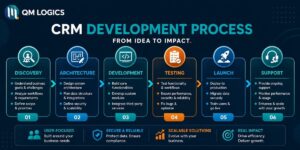
At QM Logics, our CRM development process starts with a structured discovery session. We map current workflows, identify gaps, and finalize the system architecture before any code gets written. That session consistently surfaces requirements that were not obvious in the initial brief.
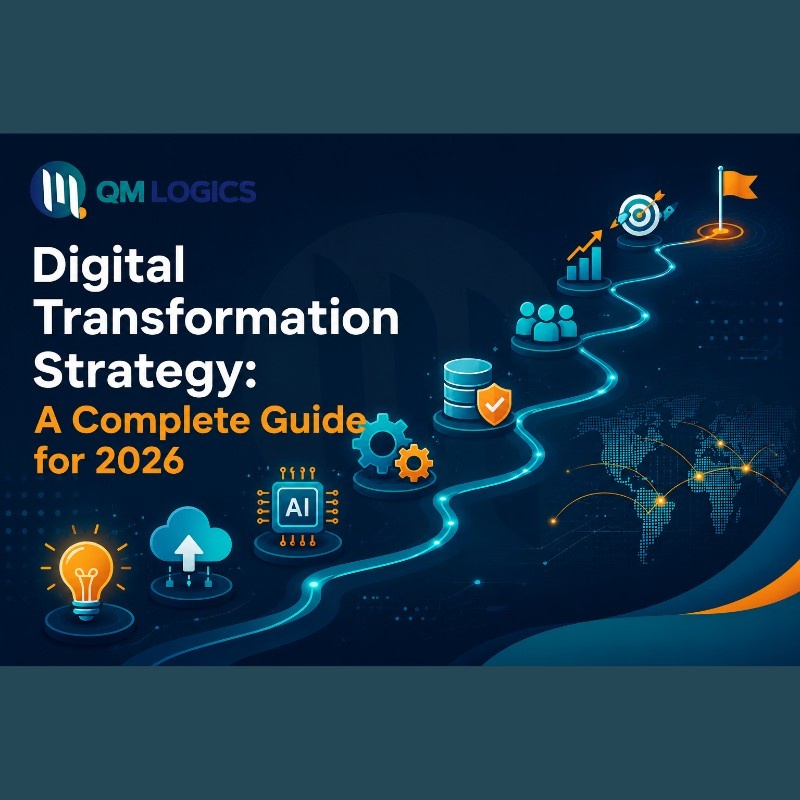
Our work also ties directly into the digital transformation strategy. If you are rethinking your entire operational setup, our digital transformation strategy guide covers how CRM development fits into a broader business upgrade.
Customer Relationship Management Best Practices That Drive Real Results
Building or buying a CRM handles only half the job. How you implement it determines whether your team actually uses it.
Research shows businesses generate $8.71 in returns for every $1 invested in CRM software. That ROI only appears when the system is built around how people actually work, not how a vendor thinks they should work.
Customer relationship management best practices worth following:
- Get your sales and support teams involved in planning before any development starts
- Define what a “qualified lead” and a “closed deal” mean in your specific process first
- Automate the most repetitive tasks first, follow-up reminders, status updates, and notifications
- Design dashboards for what your team needs to see daily, not every metric the system can produce
- Build regular data audits into your process from the start, not six months after launch
Customer relationship management model considerations:
| Factor | What to Define Early |
| Lead lifecycle | How a contact becomes a deal in your pipeline |
| Data ownership | Who enters, edits, and owns each record |
| Automation triggers | What actions fire reminders or updates |
| Reporting cadence | Daily, weekly, or monthly tracking needs |
| Integration points | What external tools must connect to your CRM |
Customer relationship management strategies should also account for growth. The custom CRM development solutions you build today need to scale without requiring a full rebuild in two or three years.
AI integration is becoming standard in newer CRM development projects. According to recent data, 65% of businesses using AI in their CRM are 83% more likely to exceed their sales targets. Connecting intelligent automation to your customer relationship management system is now a practical addition, not a future upgrade. Our custom software development guide covers how we approach this kind of technical decision-making for clients.
“The question is not whether your business needs strong CRM capabilities. It is whether you will settle for generic tools or invest in a CRM development solution that becomes a genuine competitive advantage.”
Conclusion
CRM development is not a single decision. It is a series of decisions about your workflow, your team, your data, and where your business is heading.
Off-the-shelf platforms work well for businesses with standard pipelines and simple requirements. Custom CRM development is the better path when your processes are complex, your industry has compliance requirements, or generic tools have reached their limits.
The starting point is always the same. Map your current process. Then decide whether you are fitting your business into a platform or building a platform that fits your business.
QM Logics builds custom CRM development solutions for businesses across industries in the United States and beyond. Explore our services to see how we approach CRM and software projects from discovery through launch.
Frequently Asked Questions
What is the difference between custom CRM development and CRM customization?
Custom CRM development builds a brand-new system from scratch, designed entirely around your workflows and business logic. CRM customization modifies an existing platform like HubSpot or Dynamics 365 to better match your needs. Custom development gives complete control over every feature, field, and integration. Customization is faster, but you stay within the limits of what the platform allows you to change. When your workflows are genuinely unique, customization usually hits a wall.
What does a CRM software development company actually build?
A CRM software development company builds the software that manages your customer relationships from end to end. This includes the contact database, sales pipeline logic, workflow automation, reporting dashboards, and the integration layer that connects your CRM to other business tools. Most CRM development services today include a mobile CRM app alongside the web platform, since sales teams increasingly manage deals on the go.
How long does custom CRM development typically take?
Most custom CRM development projects run between three and six months for a full-featured system. A simpler CRM app focused on contact management and core pipeline tracking can be production-ready faster. The timeline depends on the number of integrations needed, the complexity of your workflow logic, and how clearly requirements are defined before development begins. Vague requirements are the most common reason CRM development projects run long.
What are the advantages of customer relationship management for B2B businesses?
Customer relationship management B2B advantages include centralized account data, better visibility across long sales cycles, and consistent automated follow-ups across multiple decision-makers. Businesses using CRM report an average 27% improvement in customer retention. B2B companies with complex multi-stakeholder pipelines often find that custom CRM development gives them a competitive edge that off-the-shelf platforms simply cannot replicate, especially in industries like manufacturing, financial services, and professional services.
How do I find and hire reliable CRM developers?
Start by defining what you need. A CRM built from scratch, a customized platform, or just API integrations. Look for a custom CRM software development company with verified industry experience and real client case studies. Evaluate their development process, communication quality, and what post-launch support actually looks like. Platforms like Clutch and LinkedIn are solid starting points. Always check whether they have completed CRM application development projects comparable to yours before committing.