 Web Development
 APP Development
 CRM Development
 Digital Transformation
 Generative AI
 QA Testing & Automation
Pick any fast-growing company right now. There is a strong chance that generative AI is somewhere in how they operate. Not as a side experiment. As actual infrastructure. The question most business owners are quietly asking is not “does this work?” anymore. It is “Why are we still waiting?”
That gap between knowing AI matters and actually implementing it well is where most businesses lose ground. This guide is here to close that gap. What generative AI solutions actually do, where they are delivering real results, and what separates a smart implementation from an expensive disappointment.
No fluff. Just what you need to know.
Generative AI in Business: What It Actually Does
There is a lot of noise around this topic. So let’s be direct.
Generative AI is a type of artificial intelligence that creates new content based on patterns it has learned from existing data. e.g., Text, images, code, reports, synthetic datasets, product descriptions, etc. It does not just analyze what is already there. It produces something new from it.
Older AI systems classify and predict. They look at last quarter’s sales and tell you which region underperformed. Generative AI looks at the same data and writes the executive summary, builds the forecast model, and drafts the report for the board. That is a different level of capability entirely.

As of 2025 data, 88% of organizations are using Generative AI in at least one business function. Enterprise spending on AI hits $11.5 billion to $37 billion in 2025, which is more than a 3x jump in twelve months. Businesses are not piloting anymore. They are committing.
Generative AI for Customer Support: Fast Results, Real Numbers
If there is one place where generative AI integration shows up fast in the numbers, it is customer support.
Not because chatbots are cheap to run. Because the good ones are actually good now.
Modern AI agents understand context. They remember what a customer asked two interactions ago. They detect frustration in language patterns and know when pulling a human into the conversation is the right call. That is a completely different animal from the rigid, menu-based bots businesses put up with for years.
Here are the real-life examples: One global telecom company deployed AI agents for front-line support. First response time dropped by over 60%. Customer satisfaction held. The support team did not shrink; they shifted to handling the complex cases that genuinely needed human judgment.
BCG found that customer service generates 38% of AI’s total measurable business value across industries. For any business dealing with high query volume, generative AI for customer support is not a feature conversation. It is a cost and experience conversation.
Generative AI in Healthcare: The Examples That Stop People Mid-Sentence
Healthcare feels like the industry where AI adoption would move slowest. Too much regulation. Too much at stake. The reality has been the opposite.
Synthetic data is another one worth understanding. Hospitals need large, diverse datasets to train AI models, but patient records are protected. Generative AI creates realistic synthetic patient data with the same statistical properties as real records. Researchers get what they need for model training. Patient privacy stays intact.
A hospital in Yorkshire, England, used an AI model to correctly predict hospital transfers in 80% of cases. That kind of early warning changes how care gets delivered.
Generative AI for Sales and Ecommerce: Where the Efficiency Is Obvious
Sales teams have been promised efficiency by software for twenty years. Most of it delivered marginal gains wrapped in complicated dashboards.
Generative AI is different because it removes the actual time-consuming work, not just the reporting around it.
Generative AI Benefits in E-commerce
A salesperson used to take 40 minutes to research a prospect and compose a cold prospecting email, but this is done in seconds with the system. It fetches the prospect’s industry, the latest company updates, the position, and behavioral factors before composing a customized message. The rep reads, adjusts as necessary, and sends. Total Time is 3 minutes.
In e-commerce and retail, the story runs side-by-side. Generative AI creates targeted ad variations, writes product descriptions, and personalizes homepage content in real time based on who is browsing. Smart forecasting models combine seasonal trends, sales history, and market data to keep inventory sharp.
General Motors integrated generative AI into their system. The system is designed in such a way that it scans components designed for structural issues, recommends lighter materials, and flags inefficiencies before a single physical prototype is built. Lighter vehicles, lower production costs, faster iteration.
Generative AI for Data Analytics: The Gap Between Data and Decision
Most businesses are not short on data. They are short on the bandwidth to make sense of it consistently.
A team that needs insight used to submit a request to analytics, wait a few days, get a dashboard, and then interpret it. That cycle is too slow for how fast business decisions need to happen now.
With the right generative AI development services, a non-technical team member types a plain-language question and gets a clear answer pulled from real internal data. No SQL. No waiting. No translation layer.
Here is what that looks like in practice:
| Capability | What Changes |
| Natural language data queries | Any team can access insights without technical help |
| Automated report generation | Hours of manual work done in minutes |
| Predictive trend modeling | Strategy built on what is coming, not what has already happened |
| Synthetic data for AI training | Models improve without touching sensitive data |
Platforms built on GCP(Google Cloud Platform ), AWS(Amazon Web Services), TensorFlow, PyTorch, and Vector DB are making this accessible well beyond large enterprises. Mid-sized businesses with the right implementation partner can run these same capabilities.
Conversational AI vs Generative AI: They Are Not the Same Thing
This comes up in almost every AI conversation, and it causes real confusion.
Conversational AI is built for dialogue. It powers voice assistants, chatbots, and automated response systems. It listens, understands, and replies. Think customer service agents, scheduling tools, and FAQ handlers.
While the Generative AI is the wider category. It creates. It codes, designs, writes, builds models, summarizes documents, and generates images. Conversational AI is one application sitting inside the much larger generative AI space.
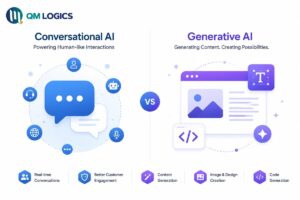
A straightforward way to think about it:
- Conversational AI handles a return request, books a meeting, and answers a product question
- Generative AI writes your entire product catalog, generates a marketing campaign from a one-line brief, builds a custom risk model, and condenses a 200-page contract into a two-page summary
Most strong generative AI solutions combine both. A conversational front end that customers interact with, powered by a generative AI engine underneath doing the heavy work.
Generative AI Security: What Cannot Be Skipped
Security is one of the first places where poorly planned AI implementations create real problems. The risks are not theoretical.
Data leakage is when models request data that they shouldn’t. When AI generates confident and fluent content that is incorrect, it produces hallucinations. Unauthorized access occurs when permissions were not thought out well enough before deployment.

Cost is another risk that gets overlooked until it is too late. In 2026, one unnamed company reportedly spent close to 500 million dollars on Claude AI in a single month, not because of a technical glitch, but because no usage limits had been set for employee licenses. With agentic AI tools capable of consuming far more tokens than basic queries, unrestricted access quickly spiraled into a massive bill. The incident became a wake-up call across the industry, reinforcing that usage monitoring and clear governance policies matter just as much as choosing the right model or vendor.
Responsible Generative AI Integration Solutions
RAG (Retrieval-Augmented Generation): Instead of relying solely on what the model learned during training, RAG pulls live verified information from your internal knowledge base before generating a response. Accuracy improves significantly. Hallucinations drop.
Role-based access controls: Not every team member should be able to query every dataset. Proper permissions protect the data that needs protecting.
Human-in-the-loop review: For high-stakes outputs, a human checks before anything goes live. In healthcare, legal, and finance, especially, this is not optional.
Audit trails: Every interaction logged, every output tracked. In regulated industries, this is a compliance requirement, not a suggestion.
For businesses in healthcare, finance, or legal, choosing generative AI development companies with genuine compliance experience matters more than almost any other factor in vendor selection.
How to Choose Generative AI Development Services That Actually Deliver
The market for generative AI vendors is crowded and loud. Everyone claims capability. Fewer can actually demonstrate it with specificity about your use case.
Here is what separates strong generative AI integration services from average ones:
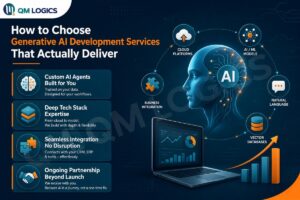
Custom AI agents vs. plug-and-play tool: Generic models produce generic outputs. A model trained on your data, your customers, and your workflows will outperform an off-the-shelf tool in almost every scenario. The customization is where the actual competitive edge lives.
Tech stack depth: A provider working comfortably across GCP, Microsoft Azure, AWS, TensorFlow, PyTorch, OpenAI APIs, Python, Node.js, and Vector DB can build more adaptable systems than one operating in a narrow stack. Your needs will evolve. The architecture needs to accommodate that.
Integration without disruption: A generative AI solution that cannot connect cleanly with your existing CRM (Customer Relationship Management), ERP (Enterprise Resource Planning), or communication platforms creates friction that undermines the efficiency gains it was supposed to deliver. Real integration capability is baseline, not a premium feature.
Ongoing partnership: The first deployment is never the finished product. Models drift. Business needs to shift. New use cases emerge six months in. A vendor who disappears after launch is not a real partner in any meaningful sense.
At QM Logics, the engagement covers strategy, development, deployment, and ongoing optimization together. Not as separate conversations with separate teams.
Generative AI and Digital Transformation: Same Conversation, Different Labels
A lot of businesses treat digital transformation and generative AI as separate roadmap items. They are not.
Generative AI is what makes digital transformation actually deliver on what it promises. Without it, transformation often means a new software stack doing the same old things slightly faster. With it, intelligence gets embedded into how the business actually runs.
The companies seeing the strongest results are not using AI as a tool they log into occasionally. They are building it into core operations: how content gets created, how customers get served, how decisions get made.
Industries with high AI adoption are growing revenue per employee three times faster than those without it. Specifically in the supply chain, 41% of companies reported cost reductions of 10% to 19% after implementing AI effectively. These are 2025 figures, not projections.
Best Generative AI Optimization Techniques in 2026
Getting AI deployed and getting real value from it are two genuinely different things. These are the techniques that separate implementations that compound over time from those that plateau fast.
Prompt engineering: How the model gets instructed shapes the output more than most people expect. Well-structured prompts reduce errors, improve output consistency, and cut revision time significantly.
Fine-tuning on proprietary data: A model trained on your products, your tone, and your specific customer interactions will outperform a general-purpose model every time. This is where the differentiation actually happens.
RAG architecture: Feed the model verified, live information from your internal knowledge base. It stays accurate and grounded rather than generating plausible-sounding but incorrect outputs.
Continuous feedback loops: When the AI produces wrong or suboptimal outputs, those corrections need to flow back into the system. Models that cannot learn from mistakes stagnate. Ones with proper feedback loops improve over time.
Clear benchmarks from day one: Before deploying, define what success looks like. Output quality, task completion rate, and time saved per workflow. Measure consistently. Adjust based on real data.
Conclusion
The gap between businesses using generative AI properly and those still in planning mode is growing faster than most people realize. The technology itself is not slowing down. Neither are the companies that have committed to it.
Getting it right is about more than picking a tool. It is about the right partner, the right architecture, and integrating AI into actual operations rather than running it as a side initiative nobody quite owns.
When you are ready to move past planning, QM Logics builds generative AI solutions around your specific business, not around a template.
Frequently Asked Questions
What is generative AI in simple terms?
It is an AI(Artificial Intelligence) that creates new content by learning patterns from existing data. Text, images, code, audio, reports. Rather than just analyzing what already exists, it generates original outputs from what it has learned.
How can generative AI be used in cybersecurity?
It simulates attack scenarios so teams can train against realistic threats. It automates vulnerability detection, generates threat intelligence summaries, and powers anomaly detection systems that flag unusual behavior before it becomes an actual breach.
What separates generative AI from traditional AI?
Traditional AI analyzes and classifies existing information. Generative AI creates new content from it. Traditional AI might flag a suspicious transaction. Generative AI writes the investigation report, drafts the client communication, and recommends updated protocols, all triggered by the same event.
Is generative AI safe for business use?
Yes, when built correctly. The risks around data privacy, hallucinations, and unauthorized access are real but manageable with the right architecture. RAG systems, access controls, and human review layers handle the majority of concerns. Working with experienced generative AI integration services means compliance and security are built in from the start rather than patched on later.
Which industries benefit most from generative AI solutions?
Healthcare, retail, finance, manufacturing, and customer service are showing the clearest returns right now. Any industry dealing with high content volume, complex data, or repetitive decision-making is a strong candidate for generative AI development services.