 Web Development
 APP Development
 CRM Development
 Digital Transformation
 Generative AI
 QA Testing & Automation
Here are points that most businesses learn the hard way. You go with a popular tool, your staff spends weeks configuring it, and 6 months later, you’re paying for workarounds to make it work when it doesn’t. This frustration is likely to encourage individuals to turn to custom software development.
Custom software development means building software from scratch for your specific business. Not for a general audience, not for a thousand different companies. Just yours. Every feature serves your workflow, every report reflects your data, and every integration connects to exactly what your team already uses.
The global custom software development market hit $53.02 billion in 2025 and is heading toward $334.49 billion by 2034 at a 22.71% CAGR (Precedence Research). Trends are not the reason why companies are adopting custom software development solutions. They’re headed that direction because generic tools continue to let them down at scale.
What Is Custom Software Development?
Custom software development is the process of designing, building, testing, and maintaining software for one specific business or use case. No one else runs the same product. No licensing it to competitors.
The simplest way to understand it: off-the-shelf software serves everyone. Custom-developed software serves just you. When your business has workflows, compliance requirements, or user needs that a generic product can’t handle, this is where you end up.
| Factor | Custom Software | Off-the-Shelf |
| Workflow fit | Built around yours | You adapt to it |
| Scalability | No ceiling | Often capped |
| Integrations | Planned from day one | Bolted on later |
| Competitive edge | Unique to you | Same as competitors |
| Long-term cost | Decreases over time | Licensing keeps growing |
Real-World Custom Software Development Examples Worth Studying
Netflix built its recommendation engine entirely in-house. It collects viewing behavior, pause points, and search patterns. Machine learning figures out what each user most likely wants to watch next. No off-the-shelf streaming product comes close to this.
Uber hit a wall when global expansion started breaking its original codebase. Adding any feature required developers to understand the whole system. So they rebuilt it as microservices: separate services handling trip management, dispatch, payments, and ETA calculations. Each team owned its piece. Bugs stopped cascading, and scaling became precise.
Amazon’s situation was similar. Rapid growth broke their original monolithic system. They split it into independent services communicating through APIs, with each part scaling on its own terms. That same infrastructure eventually became AWS(Amazon Web Services). A custom software development solution built for an internal problem became one of the most profitable business units ever built.
Benefits of Custom Software Development for Businesses
The practical question most decision-makers ask is: Why not just buy something ready-made? The honest answer is that it depends on how specific your operations are.
Custom software fits your workflows exactly. Your team doesn’t bend around a product’s limitations. Integrations with your existing CRM, ERP, or payment stack get planned at the start, not patched in six months later when problems show up.
Security is another place where generic tools fall short. Off-the-shelf products are widely known attack targets. Custom application software development lets you build security protocols around your specific requirements: HIPAA for healthcare, PCI-DSS for fintech, and SOC 2 for SaaS businesses. No paying for features your team never touches.
Custom Software Development Services and the Tech Stack Behind Them
This is where most guides stay vague. The right service type depends on your users, your industry, and where the operational gaps actually sit. But the technology stack behind the solution matters just as much.
Custom Web and Mobile Software Development: Tech That Gets the Job Done
Custom web software development covers internal dashboards, admin portals, SaaS platforms, and progressive web apps. For frontend development, React JS is the dominant choice for dynamic interfaces. Next.js builds on top of React JS and adds server-side rendering, along with much better SEO performance out of the box.
On the backend, Node.js with Express.js handles high-concurrency operations cleanly. Python with Django brings a more structured, batteries-included approach to backend development. Flask is the lighter Python option for teams that want more control over what they include. PHP with Laravel remains a solid choice for businesses with existing PHP infrastructure. WordPress powers content-heavy platforms effectively. Shopify handles e-commerce with a strong ecosystem of custom extensions built on top of it.
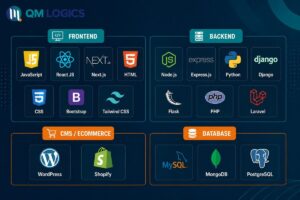
For databases, PostgreSQL handles complex relational data reliably. MySQL is battle-tested for transactional systems and still widely deployed. MongoDB fits situations where data structures change fast or content is unstructured.
Frontend styling works on a foundation of HTML and CSS. Bootstrap speeds up responsive layout development considerably. Tailwind CSS is gaining ground fast because it keeps styling maintainable at scale without fighting against pre-built components. Teams pick between Bootstrap and Tailwind CSS based on project size, design complexity, and how much customization they need. JavaScript ties all of it together on the frontend.
Custom mobile software development builds apps for users who are constantly moving. Field service teams, healthcare workers, and logistics staff all need apps that work offline, use GPS, and handle device-specific functionality that web tools don’t manage cleanly.
Custom Fintech, E-commerce, and Logistics Software Development
Custom fintech software development covers payment gateways, lending platforms, compliance engines, and real-time fraud detection. Python handles data processing and machine learning workflows in fintech particularly well. Node.js manages real-time transaction processing at high volume. PostgreSQL and MongoDB handle financial data at scale, depending on how structured that data needs to be.
Custom e-commerce software development solves problems that Shopify’s standard setup and WooCommerce can’t handle. Multi-vendor marketplaces, subscription billing, complex inventory rules, and non-standard checkout flows all need a tailored build. Next.js paired with a Node.js or Laravel backend is a common stack for this type of work. Asia Pacific is growing at 25.32% CAGR in e-commerce development alone (Grand View Research).
Custom logistics software development covers route optimization, fleet tracking, warehouse systems, and supply chain visibility. Logistics operations are almost always too specific for standard ERP modules. Transportation and manufacturing companies build custom because the operational complexity doesn’t map to any generic product cleanly.
Custom Software Development Process: Step by Step
Knowing the process helps you ask better questions and catch red flags before signing anything. Here’s how a competent team actually runs it.
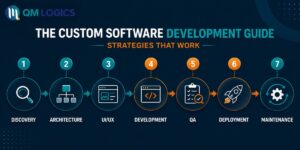
- Discovery comes first, always. Business problems, user roles, integration requirements, and compliance needs get mapped before a single line of code is written. Skipping this is why most projects go over budget.
- Architecture is next. Tech stack selection, database design, and integration planning happen here. Poor calls at this stage create expensive problems six months later.
- UI/UX Design produces wireframes and prototypes before development starts. Feedback at this stage costs a fraction of what post-development revisions cost.
- Agile Development runs in two-week sprints with working deliverables after each one. You see what’s being built in real time, not at a final handoff after months of silence.
- QA and Testing runs throughout development, not just at the end. Unit tests, integration tests, performance tests, and security audits are embedded in every sprint.
- Deployment to AWS, Azure, or Google Cloud is standard. Infrastructure choices here directly affect scalability and long-term operating costs.
- Maintenance is ongoing. Bug fixes, security patches, and new features are part of the engagement lifecycle, not optional extras to negotiate later.
Custom Software Development for Startups and Product Companies
Custom software development for startups works best when scoped tightly from the beginning. Build an MVP with core features only. Ship it fast. Learn from real users. Then iterate with actual data instead of assumptions.
Before any work starts, five questions need clear answers:
- What is the one core problem this solves?
- Who are the primary users?
- What platforms are needed?
- What existing tools does it need to connect to?
- What does success look like in 12 months?
Custom software product development is a distinct category. Here, the software itself is the product being sold or licensed. Multi-tenancy, subscription models, onboarding flows, and SLA commitments all need planning from the start. Visit QM Logics for more details on how that engagement typically works.
How to Find the Best Custom Software Development Company
The market keeps growing. More vendors mean more noise. Knowing what to look for cuts evaluation time down considerably.
Domain-specific experience comes first. A team that has built fintech software already understands compliance requirements you’d otherwise spend months explaining. Ask for case studies from your industry specifically, not a general client logo grid.
Development methodology matters as much as the portfolio. Do they use Agile sprints? How do they handle scope changes mid-project? A team that can’t explain their process clearly is a red flag, regardless of how polished the presentation is.
IP ownership needs to be explicit in the contract. “If you are paying to have software written, the developer should hand over all copyrights at the end of the project”, according to Blueberry Consultants. Some vendors try to retain licensing rights while still billing full development rates. Get this written, not assumed.
Post-launch support is where many partnerships fall apart. Confirm bug handling, response time commitments, and whether support is included or billed separately before signing anything.
Custom Offshore Software Development Services vs USA-Based Teams
Custom offshore software development services make practical sense when you need speed without scaling internal headcount. Eastern Europe, South Asia, and Latin America all have mature, skilled development communities. The global developer pool reached 28.7 million in 2025, according to Statista.
North America leads the global market at 34% share. For businesses in healthcare, finance, or government, custom software development USA teams simplify data residency and compliance obligations considerably. Many companies run a hybrid model: product leadership stays in-house, execution partners offshore. It’s a workable balance between cost and control.
Key questions worth asking any partner before committing:
- What methodology do you use, and how are scope changes handled?
- Who owns the IP and source code at project completion?
- Are developers dedicated exclusively to our project?
- Can you share references from similar industry projects?
- What does post-launch maintenance actually cover?
For customized software development services across web, mobile, fintech, logistics, and enterprise applications, browse the QM Logics blog for detailed guides on how these engagements work in practice.
Conclusion
Custom software development isn’t the right call for every business. But for companies where workflows are specific, compliance is strict, or the software itself is the competitive edge, it’s one of the most practical investments on the table.
Netflix didn’t lead its market using someone else’s tools. Uber and Amazon didn’t either. The right development team, a clear discovery process, and a focused first version are what separate projects that deliver from ones that drain budgets. Start with those three things, and everything else follows.
Frequently Asked Questions
What is custom software development?
Custom software development is the process of designing and building software for one specific business or use case. Every feature, integration, and workflow is built around the requirements of a single organization, not a general market.
What tech stack is used in custom software development?
It depends on the project. Frontend work commonly uses React JS, Next.js, HTML, CSS, Bootstrap, and Tailwind CSS with JavaScript tying everything together. Backend options include Node.js with Express.js, Python with Django or Flask, and PHP with Laravel. WordPress and Shopify handle CMS and e-commerce use cases. For databases, PostgreSQL, MySQL, and MongoDB are the most commonly used choices.
How long does custom software development take?
A focused MVP or internal tool typically takes 3 to 4 months. Full enterprise platforms usually take 12 to 18 months or longer. How accurate any estimate is depends almost entirely on how well discovery and requirements gathering are handled upfront.
Is custom software development only for large companies?
No. SMEs(Small and Medium-sized Enterprises) are one of the fastest-growing market segments. Cloud infrastructure, Agile development, and productized service models have made custom software development solutions accessible at nearly any business size.
Can custom software integrate with existing tools?
Yes. Integration with existing CRMs, ERPs, payment platforms, and third-party APIs is a standard part of any custom software development engagement. It’s one of the main reasons businesses choose custom application software development over off-the-shelf alternatives.