 Web Development
 APP Development
 CRM Development
 Digital Transformation
 Generative AI
 QA Testing & Automation
Trillions spent. 70% failure rate. That is where digital transformation stands in 2026.
Not because the technology is bad. The technology is genuinely impressive. The failure happens before anyone opens a single platform. It happens at the strategy level, or more accurately, the absence of one.
This guide covers what a real digital transformation strategy looks like, which tools and frameworks are actually used, and what separates the 30% of businesses that succeed from those burning through their budgets with nothing to show for it.
What Digital Transformation Strategy Actually Means
People mix up digitization and digital transformation constantly. Digitization is converting paper invoices into PDFs. Digital transformation is questioning whether invoices should exist in that form at all and rethinking the entire process around them.
A digital transformation strategy is the plan that answers three questions before any money moves:
- What are we actually trying to change?
- Why does changing it matter to the business?
- How will we know it worked?
Deloitte found that companies aligned on these questions hold 14% higher market value than competitors who are not. For Fortune 500 firms, that gap sits around $2.75 trillion. Worth taking the planning seriously.
“Technology without direction is just expensive chaos with better branding.”
One thing that surprises most people is that smaller organizations consistently outperform larger ones here. Businesses with 100 or fewer employees succeed at digital transformation 2.7 times more often than enterprises with 50,000+ people. Speed and clarity beat organizational weight every time.
Digital Transformation Strategy Framework: What the Successful 30% Build First
Before any cloud contract gets signed or an AI tool gets demoed, the businesses that actually succeed build on five pillars simultaneously.
Here are the 5 Most Important Pillars of Digital Transformation
| Pillar | What It Covers |
| People | Culture shift, managing resistance, genuine upskilling |
| Process | Fixing broken workflows before automating them |
| Technology | AWS, GCP, Azure, OpenAI, RPA, API integrations |
| Data | Decisions made on numbers, not gut feel |
| Security | Cybersecurity and compliance are built in from day one |
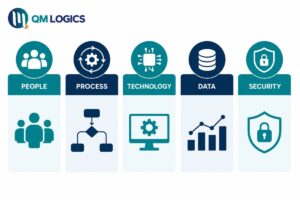
Notice technology is pillar three, not pillar one. That ordering matters more than most businesses realize.
Gartner reports 81% of organizations will adopt zero trust frameworks by 2026; that number reflects years of treating security as an afterthought and paying for it.
McKinsey’s 7S Model and BCG’s Digital Acceleration Index both give solid structural guidance. Neither framework matters as much as having all five pillars moving together at the same time.
AI and Digital Transformation: What Is Real in 2026
Where AI Actually Lives Inside Businesses Now?
Forget the pitch decks. McKinsey’s latest research puts AI adoption at 78% among enterprises, up from 72% the year before. Generative AI specifically is running inside:
- Customer service workflows
- Developer tooling and code generation
- Supply chain forecasting
- Internal knowledge systems
PwC found 41% of companies reported measurable improvement in customer experience after AI adoption. Another 40% reported genuine productivity gains. Healthcare, finance, and manufacturing are leading. B2B digital transformation and e-commerce are closing the gap fast.
The businesses sitting on the sidelines waiting for AI to “mature” are already behind the ones running it in production.
OpenAI and Microservices: The Architecture Worth Knowing
Pairing OpenAI capabilities with a microservices architecture is one of the more pragmatic moves available right now. You do not rebuild your entire product. You add intelligence to specific functions that need it; customer support gets smarter, internal search improves, and reporting accelerates. Everything else keeps running as it already does.
Cloud Platforms: AWS, GCP, and Microsoft Azure in Practice
According to my Research, Global public cloud spending is crossing $1 trillion in 2026. Nearly 85% of enterprises have committed to cloud-first operations. The platform question is real, and the answer depends entirely on what your business already runs and where you are going.
| Platform | Best For |
| AWS(Amazon Web Services) | Largest service catalog, broadest enterprise adoption, maximum scalability |
| Microsoft Azure | Microsoft stack users, hybrid cloud, and compliance-heavy industries |
| GCP(Google Cloud Platform) | Machine learning workloads, big data pipelines, and AI-heavy development |
Most organizations worth their IT budget are going multi-cloud now. Vendor lock-in is a real risk, and the market learned that lesson expensively in the early cloud years.
Digital Transformation Best Practices: What Actually Separates Results from Reports
Only 30% of companies successfully navigate transformation. Here is the practical difference between them and the rest.
Define the business problem before looking at technology. The question is never “How do we use AI?” It is “What specific friction in our operations costs us the most?” One produces results. The other produces demos that nobody uses six months later.
Leadership must be actually committed. TEKsystems found digital leaders are 2.5 times more likely to embed transformation as a genuine pillar of business strategy. When a CEO treats it as a priority, budgets move, resistance shrinks, and teams stop treating it as an IT project nobody asked for.
RPA goes in early for the repetitive work. Robotic Process Automation handles:
- Invoice processing
- Compliance checks
- Data entry
- Report generation
These are automated in weeks. The time recovered compounds into real capacity over months.

API integrations connect everything early. Disconnected tools create data silos; silos create manual handoffs; handoffs create errors. Getting API integrations in early means your CRM, ERP, marketing stack, and support system actually share data. That is where transformation starts, multiplying rather than just operating.
Culture investment goes alongside technology investment. Organizations that invest seriously in culture change alongside tools see 5.3 times higher success rates than technology-only approaches (Integrate.io, 2026). The number is not subtle.
Digital Transformation Case Studies: Walmart and Amazon
Walmart’s Decade of Intentional Execution
When Amazon started eating retail, Walmart built a strategy rather than panic-purchasing technology. They stood up a dedicated ecommerce division and built proprietary tools nobody else had access to:
- Polaris is their semantic search engine, improving how customers actually find products
- Shopycat used social data and big data analysis to surface gift recommendations
- Walmart Element applied machine learning directly to supply chain and sales channel optimization
Today, Walmart is the second-largest online retailer in the United States, generating over $161 billion per quarter in ecommerce. That outcome came from a decade of disciplined execution. Not a single big-bang technology purchase.

What Amazon Did to Logistics That Nobody Talks About
Everyone discusses AWS. The more instructive story is logistics. Amazon applied AI, robotics, real-time data, and relentless iteration to turn delivery speed into a competitive moat no competitor has matched at scale. A function that should have been a cost center became their strongest market advantage. Every technology decision followed the strategy. None of it happened the other way around.
Digital Transformation Challenges That Actually Kill Projects
These are the ones that show up repeatedly in failed transformation post-mortems:
- Skills gap: 54% of companies name lack of expertise as their primary transformation barrier according to IDC. You either hire the capability or partner with organizations that already have it. Assuming your current team figures it out under deadline pressure is not a plan.
- Employee resistance: New systems threaten the routines people have built entire careers around. Change management is not soft work; without it, adoption rates collapse, and expensive tools collect dust while the project quietly dies.
- Legacy systems: Old infrastructure limits what modern tools connect to, creates security vulnerabilities, and slows every integration attempt. Addressing technical debt early is painful. Addressing it after three failed integrations is catastrophic.
- Compliance: Financial services, healthcare, and manufacturing operate inside strict regulatory frameworks. Compliance cannot be retrofitted after the architecture is built. It belongs in the design from day one.
- Tool fatigue: By 2026, many organizations will have accumulated overlapping platforms with rising costs and unclear ownership. Consolidation has become a legitimate transformation strategy in itself.
Supply Chain Digital Transformation in Manufacturing
Manufacturing is where digital transformation currently pays back fastest. McKinsey reports 80% of manufacturers are using digital tools to optimize supply chains in 2026. The tools doing the real work include:
- Predictive maintenance systems
- IoT sensors for real-time visibility
- Automated procurement workflows
- Inventory management platforms

For any business still running supply chain operations on spreadsheets and email threads, this is the highest ROI entry point. Reduced downtime, lower waste, faster delivery, and better supplier relationships compound on each other once the right tools are properly connected.
Digital Transformation Customer Experience: The Revenue Connection
Internal operations get most of the attention in transformation conversations. Customer experience is where the revenue actually moves.
A connected customer experience means your CRM, website, mobile app, and support system share real-time data. You personalize communication. You predict customer needs before they surface as complaints. You resolve issues faster than competitors, even when they recognize that there was a problem.
KPMG found 87% of organizations used technology to increase profits in the past 24 months; among them, 59% saw profits grow by at least 11%. The businesses driving those numbers are the ones where transformation reached customers, not just internal dashboards.
Building a Digital Transformation Strategy Roadmap
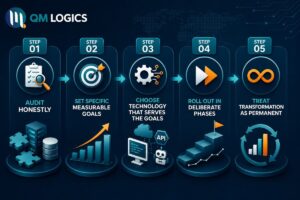
Step 1. Audit honestly before spending anything. Map your current technology stack, team capabilities, and organizational culture. Find every gap before committing a single dollar to new platforms.
Step 2. Set specific measurable goals. “Become more digital” is not a goal. “Reduce manual reporting time by 50% within six months” is a goal. Vague targets produce vague outcomes and make it impossible to know whether anything worked.
Step 3. Choose technology that serves the goals you defined. Select your cloud platform, automation tools, AI integrations, and API layer based on actual objectives. Not on what appeared in a vendor presentation last quarter.
Step 4. Roll out in deliberate phases. Start where impact is highest. Prove the results. Then scale. Quick wins build organizational momentum and make every subsequent phase easier to fund and defend internally.
Step 5. Treat transformation as permanent. It does not end. Markets shift, customer expectations change, and new technology surfaces. The roadmap is a document you review quarterly, not a PDF you file after go-live.
Conclusion
70% failure rate. $2.3 trillion wasted annually. These numbers do not mean that digital transformation does not work. They mean most organizations skip the strategy and go straight to the spending.
The 30% that succeed are not necessarily better funded or more technically advanced. They start with clarity on what they are changing and why. They bring leadership and people along rather than surprising them with new systems. They execute in phases and measure what actually matters.
The tools are available. AWS, Microsoft Azure, GCP, OpenAI, RPA platforms, and microservices architecture. None of it is inaccessible anymore.
What separates the 30% from the rest is the strategy built before a single platform gets purchased.
If your business is ready to build that strategy and execute it properly, QM Logics offers digital transformation services built around your actual business goals. From cloud migration and AI integration to CRM development and QA automation, the right partner makes the difference between a transformation that works and one that gets added to the $2.3 trillion.
Frequently Asked Questions
What are the four main areas of digital transformation?
Customer experience, operational processes, business models, and organizational culture. Most failed projects focus only on technology and miss three of the four. That is usually where the 70% failure rate comes from.
How long does digital transformation actually take?
Most organizations see meaningful results within 12 to 18 months of focused execution. Walmart has been running it for over a decade and still treats it as a current priority. There is no finish line.
What separates digitization from digital transformation?
Digitization converts a physical process to a digital format. Transformation rethinks how your business delivers value using technology at its foundation. One is a task. The other is a strategy that never stops.
What does cybersecurity have to do with digital transformation?
Every new tool, cloud migration, and API integration expands your attack surface. Security is a foundational pillar, not a layer you add later. Zero-trust architecture needs to be in the design from the first planning session.