 Web Development
 APP Development
 CRM Development
 Digital Transformation
 Generative AI
 QA Testing & Automation
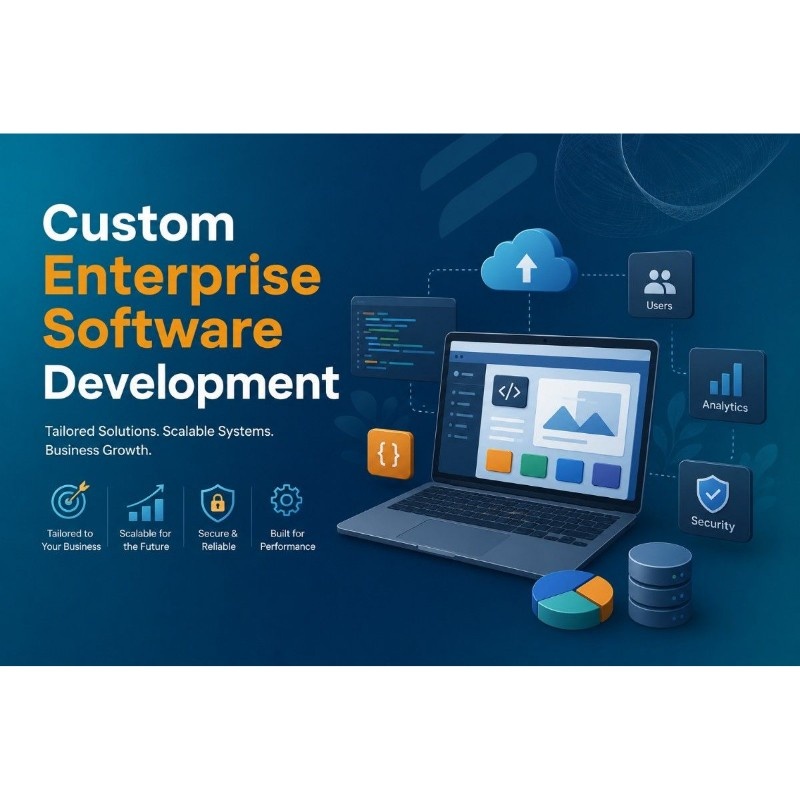
The most searched question on Reddit and Quora about this topic is not technical. It is simple. Is custom enterprise software development really worth the assets and money when off-the-shelf tools already exist? And honestly, that question only comes from people who have not yet felt the full cost of the wrong software. Because the cost of a tool that does not fit your business is not zero. It shows up in manual work, missed deadlines, frustrated teams, and growth that slows down right when it should be picking up.
Enterprise custom software development means building a system around how your business actually works. Not how a vendor thinks businesses work. Not how your industry worked five years ago. Around your actual workflows, your team, your compliance requirements, and your growth plan. The global custom software market was valued at $43 billion in 2024, and we will see it reach $146 billion by 2030. That number is moving because businesses have learned something the hard way. Generic tools have a ceiling, and most growing companies hit it faster than they expect.
The second thing people ask, especially on LinkedIn and Medium, is how to choose a software development company and not regret it six months later. That question deserves a real answer, and this article gives it.
Custom Enterprise Software Development vs Off-the-Shelf: What People Get Wrong
People frame this as a cost comparison, and that is where the thinking goes wrong. Although off-the-shelf software looks cheap upfront. But pile up the monthly subscriptions, the third-party integrations, the manual processes your team builds around the tool’s limitations, and the cost of switching when you finally outgrow it. Now compare that to custom enterprise software development services built once, owned completely, and maintained on your terms. The math changes.
Off-the-shelf wins in one specific scenario. You are new, you do not yet know what your actual workflow looks like, and you need to move fast. Use Salesforce, use HubSpot, use whatever gets you running. But stay on those tools past the point where they create friction and you are not saving money. You are just deferring a bigger problem.
When Off-the-Shelf Actually Makes Sense
Early-stage businesses and teams testing a new market should not be investing in custom software. The workflow is not stable enough yet to build around. Buy the off-the-shelf tool, learn exactly what does not work about it, and document every workaround your team creates. That documentation becomes the requirements for your custom build later.
The Real Signals That You Need Custom Enterprise Software
Your team has workarounds that have become standard procedure. You are paying for five tools that each do 70% of what you need and none of them talk to each other properly. You have turned down growth because your current system cannot handle the volume. Or your process is genuinely unique, and your competitors cannot replicate it because there is no tool on the market built for what you do. Any one of these is enough reason to have the conversation about custom enterprise software.
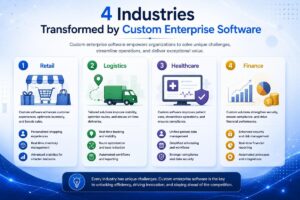
In retail specifically, custom retail software development solves something packaged tools never fully crack. Inventory, POS, loyalty programs, supplier management, and customer data living in one system built around how that specific retail operation runs. Not a plugin-patched version of Shopify with four separate integrations held together by a prayer.
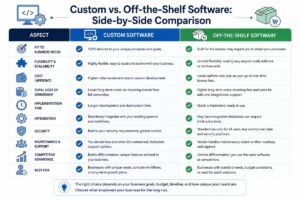
| Factor | Custom Software | Off-the-Shelf |
| Flexibility | Built for your workflow | Fixed by vendor |
| Scalability | Grows with you | Limited by subscription tier |
| Long-term cost | Higher upfront, lower over time | Low upfront, high recurring |
| IP ownership | Yours completely | You license it |
| Integration | Designed in from the start | Workarounds required |
What Custom Enterprise Software Development Services Actually Look Like End to End
People who have been through enterprise software projects and talk about it honestly on Medium and LinkedIn, all say the same thing. The projects that failed did not fail because of bad code. The main reason they failed because the process was unclear, communication broke down, and nobody caught the misaligned expectations early enough.
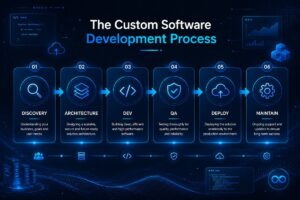
 A structured custom enterprise software development company runs the work in phases. Discovery comes first. Requirements are gathered from everyone who will actually use the system, not just whoever signed the contract. Then architecture. The system is designed before a single line of code is written. Development runs in sprints with regular client checkpoints. QA is woven in throughout, not bolted on at the end. Deployment is planned. And post-launch support is agreed on before the project starts, not after you need it.
Why Discovery Is the Phase That Decides Everything
Businesses that rush discovery rebuild features. It is that consistent. Discovery is where you document how your business operates today, where the friction is, and what the software actually needs to solve. A good development partner asks questions during discovery that surface requirements the client did not know they had. That saves months later.
A thorough discovery phase adds two to four weeks upfront and typically saves more than that in avoided rework alone. Any company that tells you discovery is unnecessary is telling you they would rather bill for revisions later.
How to Know Your Small Business Has Outgrown Off-the-Shelf Tools
You move data manually between systems more than twice a day. Your team spends more than five hours a week on tasks that should be automated. You have documented a workflow that no existing tool supports without significant compromise. You have lost a client or a deal because your system could not handle the requirements. These are not soft signals. They are clear ones.
How to Choose a Custom Enterprise Software Development Company
Most content on this topic is written by development companies trying to rank for the keyword. So the advice is predictably biased. The real guidance comes from people who hired development companies and learned what actually matters.
Industry experience is the first filter. A team that has built software in your specific space already understands your compliance landscape, your typical integrations, and your user behavior without you having to teach them. That saves weeks during discovery and prevents expensive assumptions during architecture.
 Process transparency is the second filter. Ask them to walk you through exactly how they run a project, step by step. If the answer is vague, the execution will be too. A serious development partner can describe their sprint structure, QA approach, communication cadence, and how they handle scope changes without hesitation.
Questions That Tell You More Than Any Portfolio
Ask who owns the intellectual property after delivery. Ask how scope changes are priced and whether there is a change order process. Ask to speak with a previous client from a similar industry. Ask what post-launch support looks like and whether it is included or billed separately. Ask if your project gets a dedicated project manager or gets passed between account managers. The answers to these questions reveal more about a company than three pages of case studies.
Software Product Development vs. Co-Development Software: Choosing the Right Model
LinkedIn discussions around enterprise software consistently raise this question. Should you hand the entire project off or keep your internal team involved? Both approaches work. The right choice depends on your in-house technical capability and how much control you want over decisions during the build.
Full outsourcing suits businesses without an internal technical team. You define the outcome, the development company figures out how to get there, and you review deliverables at agreed milestones. It requires clear requirements and a partner you genuinely trust to make good architectural decisions without daily supervision.
Co-development software works when you have developers or a technical lead internally who can participate in sprint reviews, architecture discussions, and code reviews. Your team stays involved in technical direction while the vendor provides capacity and specialized expertise. This model protects internal knowledge and gives you more control over decisions that will affect you long after the project ends.
Service Software Development as an Ongoing Model
Some businesses do not need a project. They need a permanent development capability without the overhead of a full in-house team. Service software development is a retainer model in which the team handles new features, bug fixes, performance improvements, and technical debt continuously. It works best for businesses with a live product that needs regular iteration. More cost-effective than building an internal team and more reliable than hiring project by project with gaps in between.
Frequently Asked Questions
Here are a few commonly asked questions from beginners.
What is custom enterprise software development?
It is the process of designing and building software specifically for one business’s workflows and goals rather than using off-the-shelf products. The system is built around how that business actually operates, not around how a vendor thinks businesses generally operate.
How long does custom enterprise software development take?
Simple tools take two to four months. Mid-complexity platforms take four to eight months. Full enterprise systems with multiple integrations typically take nine to eighteen months. The timeline depends heavily on how clearly requirements are defined before development begins.
How do I choose a custom enterprise software development company?
Start with industry experience, then evaluate process transparency. Ask about IP ownership, how scope changes are handled, what post-launch support looks like, and whether you can speak to a previous client in a similar industry. Those conversations reveal more than any portfolio.
What is co-development software?
It is a model where your internal team collaborates directly with an external development partner. Your team contributes to technical decisions and reviews while the vendor provides development capacity and expertise. Best suited for businesses with some in-house technical capability who want meaningful control over the build.
Conclusion
Custom enterprise software development is not an investment you make because it sounds better. You do it because your current tools are genuinely holding your business back, and the cost of staying on them is higher than the cost of building something that actually fits.
The businesses getting the most out of custom software in 2025 are not the ones with the biggest budgets. They are the ones who defined their requirements honestly, chose their development partner based on the right criteria, and built something focused rather than trying to solve every problem at once. That combination of clarity, focus, and the right partner is what makes the investment worth it every time.