 Web Development
 APP Development
 CRM Development
 Digital Transformation
 Generative AI
 QA Testing & Automation
Businesses that invest in professional AI agent development services are pulling ahead. Fast.
The global AI agents market was valued at $7.63 billion in 2025 and is projected to reach $182.97 billion by 2033, growing at a CAGR of 49.6%. That is not gradual adoption. That is a structural shift in how enterprise software works. Companies that delay custom AI agent development are not playing it safe. They are falling behind.
I have seen enterprise teams struggle because they treated AI agents like chatbots. They are not. Custom AI agent development builds autonomous systems that plan, reason, use tools, and complete multi-step workflows without constant human input. That distinction changes everything about how you approach the build.
What Are AI Agent Development Services?
AI agent development services cover the full lifecycle of designing, building, deploying, and maintaining autonomous AI systems for businesses. A custom AI agent is not a static tool that responds to inputs. It perceives its environment, makes decisions, calls external tools, and adapts based on outcomes.
Think of it this way. A traditional AI tool answers a question. An AI agent completes a goal.
At QM Logics, we deliver end-to-end agentic AI development services for enterprise clients across the United States. Our work covers single-agent systems for focused tasks and multi-agent architectures for complex, cross-functional workflows.
AI agent development differs from standard software engineering in one critical way: the system needs memory, planning logic, and access to tools built into the architecture from day one. Getting that right is what separates agents that work reliably in production from those that fail six weeks after launch.
AI Agent Development Tools and Frameworks You Need to Know in 2026
The tools powering AI agent development have matured quickly. Choosing the right stack is one of the most consequential decisions in the entire development process.
Here is a breakdown of the leading AI agent development software and frameworks currently in use:
| Framework | Best For | Language Support |
| LangChain / LangGraph | Stateful, multi-step AI agent workflows | Python |
| AutoGen | Multi-agent collaboration systems | Python |
| Microsoft Semantic Kernel | Enterprise-grade .NET and Java integration | Python, C#, Java |
| CrewAI | Role-based multi-agent orchestration | Python |
| OpenAI Assistants API | Rapid single-agent AI development | REST / Python |
| n8n | Low-code AI agent workflow automation | Visual / JavaScript |
| Dify | Custom AI agent model development for non-developers | Visual / Python |
IBM’s technical overview of AI agent frameworks goes deeper into how each framework handles memory, tool calling, and orchestration. Worth reading before you commit to a stack.
LangChain and LangGraph for AI Agent Development
LangChain is one of the most widely adopted AI agent development kits available today. It supports vector databases, memory modules, and external tool integrations out of the box.
LangGraph extends this with stateful, graph-based workflow control. That makes it the right choice for agents requiring branching logic, long-running tasks, or dynamic replanning.
Most of our custom AI agent development projects at QM Logics start here. The flexibility covers almost any enterprise use case without over-engineering the solution.
AutoGen and Multi-Agent AI Systems
AutoGen, developed by Microsoft Research, focuses on multi-agent collaboration. Specialized agents work together to complete complex goals. One handles research. Another writes. A third validates outputs. An orchestrator coordinates the full workflow.
This approach fits enterprise AI agent development projects where the task is too complex for any single agent to handle end-to-end. It also enables teams to scale individual agents based on demand without rebuilding the entire system.
Custom AI Agent Model Development for Non-Developers
Not every team has deep Python expertise. Platforms like Dify, Microsoft Copilot Studio, and n8n make custom AI agent development accessible to business users and operations teams through visual, low-code interfaces.
These tools are particularly useful for internal workflow automation where the primary goal is speed of deployment rather than maximum customization.
The AI Agent Development Process: Phase by Phase
AI agent development follows a clear process when done right. Gartner predicts that more than 40% of agentic AI projects will be canceled by 2027. The primary reasons are escalating costs, unclear ROI, and inadequate risk controls. A structured AI agent development process prevents exactly those failure modes.
Phase 1: Discovery and AI Agent Development Roadmap
The first step is defining the right problem. Not every task needs an AI agent. Some need a simple script. Others need a workflow tool.
Good AI agent development starts with four questions:
- What specific goal does the agent need to achieve?
- What tools, APIs, and data sources does it need access to?
- What does failure look like, and how should the system handle it?
- Who owns the outcome when something goes wrong?
At QM Logics, we spend deliberate time here before writing code. This phase alone prevents 30 to 40 percent of downstream problems.
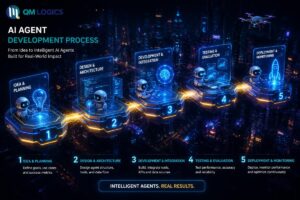
Phase 2: Architecture Design and Tool Integration
Once the use case is clear, architecture comes next. This means deciding between single-agent and multi-agent systems, selecting the right AI agent development tools, and designing the integration layer.
Key decisions at this stage:
- Memory management (short-term context vs. persistent long-term memory)
- Tool definitions (APIs, databases, external services the agent can call)
- Orchestration pattern (reactive, proactive, or goal-driven)
- Error handling and fallback logic
This phase is where agentic AI development diverges most sharply from traditional software engineering. The architecture must support non-deterministic behavior. Agents do not always take the same path to the same outcome.
Phase 3: Development, Testing, and Deployment
This phase involves building the agent, running evaluation suites, and deploying to production. Edge-case testing is mandatory. Continuous monitoring from day one is not optional. It is the difference between an agent that improves over time and one that quietly breaks.
AI Agent Workflow Automation: Real-World Applications Across Industries
This is where AI agent development services deliver the most visible ROI. The numbers are clear.
Companies using AI agents report a 55% increase in operational efficiency and 35% cost reductions on average. ServiceNow’s AI agent integration cut the time required to handle complex customer service cases by 52%. These are not projections. They are outcomes from production deployments.
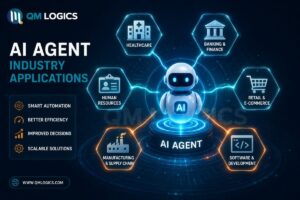
Here is how AI agent workflow automation software development applies across key industries:
| Industry | AI Agent Use Case | Documented Impact |
| Finance and BFSI | Fraud detection, compliance monitoring, client onboarding | Largest segment, ~25% market share in 2026 |
| Healthcare | Patient intake, clinical documentation, claims processing | Significant reduction in administrative workload |
| Retail and eCommerce | Personalized recommendations, inventory management | 55%+ operational efficiency gains |
| Software and SaaS | Code generation, test automation, bug triage | 52.4% CAGR, fastest-growing agent role |
| Human Resources | Employee onboarding, policy queries, benefits processing | ServiceNow reduced case handling time by 52% |
| Manufacturing | Supply chain logistics, predictive maintenance | Real-time anomaly detection and response |
Enterprise AI Agent Development in Action
Morgan Stanley built a custom AI agent development solution that gives financial advisors instant access to over 100,000 internal research documents. The agent retrieves, synthesizes, and surfaces the right information in seconds. What took hours now takes under a minute.
Salesforce Agentforce handles complex customer service inquiries 24/7. It manages case routing, context preservation, and escalations without human intervention at the first tier. That is what enterprise AI chatbot development looks like when it is production-grade.
The coding and software development segment is growing at a CAGR of 52.4% from 2025 to 2030, making it the fastest-growing agent role in the market. AI agent development is no longer just supporting developers. Agents are actively writing, reviewing, and deploying code.
Our generative AI solutions article covers how these capabilities connect with broader AI adoption strategies.
Custom AI Agent Development Services for Enterprise Companies: What to Expect
Not every AI agent development company delivers enterprise-grade solutions. There is a significant gap between building a working demo and building something reliable in production.
Here is what enterprise-ready custom AI agent development looks like:
- Production stability: Agents that handle errors gracefully, retry failed tool calls, and escalate edge cases to human reviewers
- Security and compliance: Role-based access control, audit trails, and data privacy controls built into the architecture from the start
- Scalability: Containerized deployments that scale horizontally based on real-time demand
- Observability: Structured logging, performance metrics, and distributed tracing so teams can see exactly what the agent is doing
- Integration depth: Agents that connect to your existing CRM, ERP, databases, and APIs without requiring major rewrites
“The companies that will compound through this AI cycle are not the ones moving fastest. They are the ones moving most deliberately.” That applies directly to AI agent development decisions.
Only 21% of organizations currently have a mature governance model for autonomous AI agents. That governance gap is where most enterprise AI agent development projects fail. At QM Logics, we build governance into the architecture from discovery. Not as a last-minute addition.
Our digital transformation strategy guide covers how AI agent deployment fits within a broader enterprise modernization roadmap.
How to Choose the Right AI Agent Development Company
Most enterprise teams comparing AI agent development companies focus on the wrong things. Portfolio size and team headcount matter less than production track record.
The first question I ask any vendor is simple: show me a production AI agent you have built and supported for six months or more. Anyone can ship a demo. Production is where the real skills show.
Use these 5 questions to evaluate any AI agent development company:
- What AI agent development process do you follow from discovery to deployment?
- How do you handle agent failures, hallucinations, and unexpected outputs?
- What monitoring and evaluation frameworks do you use post-launch?
- How do you manage data privacy and security in agentic systems?
- What does your post-deployment support model look like?
Experience with specific AI agent development tools matters too. A team fluent in LangGraph, AutoGen, and OpenAI’s Assistants API brings practical production knowledge. A team that has only built demos does not.
For enterprise software and SaaS companies, check out our article on Custom Enterprise Software Development and how AI is reshaping SaaS development to understand how AI agent development fits into product strategy.
QM Logics provides enterprise AI agent development solutions for US companies across software, SaaS, finance, and healthcare verticals. We build production-grade agents, not pilots.
Conclusion
AI agent development is not optional for enterprises competing in 2026. Forty percent of enterprise applications will embed AI agents by the end of this year, up from under 5% in 2025. The companies building production-grade custom AI agents today are setting the pace for the next five years.
Getting AI agent development right requires the right architecture, the right tools, and a team with real production experience behind them. Contact QM Logics, because that is exactly what we deliver. If you are ready to move from AI pilot to production-grade AI agent development, let’s build something that works.
Frequently Asked Questions
What Is the AI Agent Development Roadmap for Enterprises?
An AI agent development roadmap follows five phases: use case discovery, architecture design, core development, testing and evaluation, and deployment with continuous monitoring. Each phase has specific deliverables and gates.
Simple single-task AI agent development projects typically require 6 to 10 weeks from discovery to production. Multi-agent AI workflow automation systems require 12 to 20 weeks depending on integration complexity. The discovery phase alone eliminates the majority of costly mid-development changes. Skip it, and the timeline doubles.
What Tools Are Used in AI Agent Development?
The primary AI agent development tools in 2026 include LangChain and LangGraph for workflow orchestration, AutoGen for multi-agent systems, the OpenAI Assistants API for rapid deployment, and CrewAI for role-based agent collaboration. Infrastructure relies on Docker, Kubernetes, and cloud platforms like AWS, Azure, and GCP.
Vector databases, including Pinecone, Weaviate, and ChromaDB, are essential for agents that need to retrieve and reason over large knowledge bases. These form the backbone of RAG-powered agentic AI development services.
How Are AI Agents Changing Developer Tools and SaaS Business Models?
AI agents are fundamentally shifting the SaaS model from selling software access to selling outcomes. Traditional SaaS charges for platform usage. Agentic SaaS charges for what the agent actually accomplishes.
This changes the competitive landscape entirely. GitHub Copilot, Cursor, and Devin AI show what product-embedded AI agent development looks like at scale. The coding segment is growing at 52.4% CAGR through 2030. For B2B SaaS companies, AI agent development is no longer a feature roadmap item. It is becoming the core product.
What Is the Difference Between Custom AI Agents and Ready-to-Deploy Agents?
Ready-to-deploy agents launch quickly and work for common, well-defined tasks. They cost less upfront. The tradeoff is that they are built for general use, not your specific data, tools, or business logic.
Custom AI agent development builds agents shaped precisely around your workflows. Higher initial investment. Substantially better ROI for complex or high-stakes applications. According to Precedence Research, the custom build-your-own agents segment is expected to grow at the highest CAGR, reflecting this industry shift toward domain-specific solutions.
Most enterprise companies start with a ready-to-deploy agent to validate the concept, then invest in custom AI agent development services to scale it into production.
How Do I Start Developing an Agentic AI System?
Start with one specific, high-value problem. Do not try to automate everything in the first project.
A practical starting point: (1) identify a workflow that is repetitive, time-consuming, and has measurable success criteria; (2) map every tool and data source the agent needs to access; (3) choose an AI agent development framework that matches your team’s technical skills; (4) build a minimal agent and test it heavily against edge cases; (5) deploy with monitoring from day one.
If your team lacks the internal AI expertise to execute this, working with an experienced AI agent development company shortens the timeline and reduces risk significantly. QM Logics delivers end-to-end custom AI agent development from initial discovery through production deployment and ongoing support.