 Web Development
 APP Development
 CRM Development
 Digital Transformation
 Generative AI
 QA Testing & Automation
Three tools. $4,200 a month. Zero integration between them.
That was a client of mine six months back. His team spent two hours each day copying data from one platform to another. By hand. Every single day. When I asked him why he had not fixed it yet, he said the same thing I hear all the time. “We figured we would just make do.”
Making do is expensive. More expensive than most business owners realize until they actually sit down and do the math.
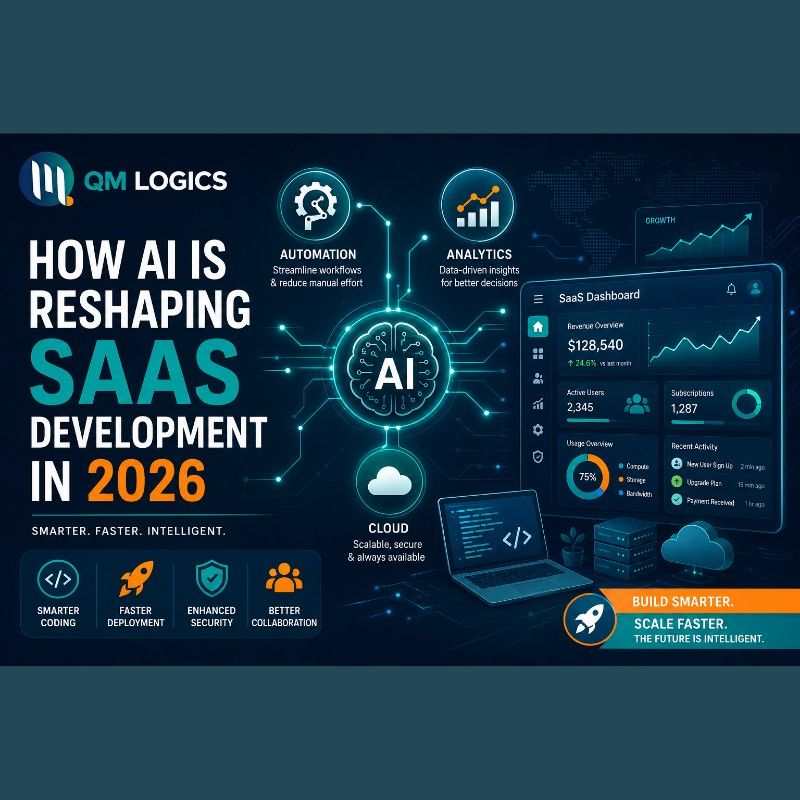
This is why custom SaaS development has become one of the most discussed topics among US businesses in 2026. Not because it is trendy. Because the financial case for it has never been clearer. And because AI has completely changed what is now possible, how fast products get built, and what they can do once they are live.
Let me tell you exactly what is happening right now.
The SaaS Market in 2026: What the Numbers Actually Say
Software spending is at $1.44 trillion globally in 2026, according to Gartner. Growing at 15.1% year over year. GenAI model spending alone is projected to grow over 80% this year. Three upward revisions from Gartner in six months. They keep underestimating demand.
On the AI side specifically, Zylo’s 2026 SaaS Management Index analyzed 40 million SaaS licenses and $75 billion in spend. Their finding: AI-native application spending jumped 108% overall. Inside large enterprises, it jumped 393% in a single year.
These are not projections. This is money already being spent.
And here is the part that matters for your business. Most of that spending is going toward software companies that figured out AI-first development early. The ones still building the old way are watching their market share compress.
What Changed in SaaS Development and Why It Matters
AI Used to Be a Feature. Now It Is the Foundation.
I remember when adding AI to a SaaS product meant putting a chatbot on the support page. Maybe a recommendation engine is buried somewhere in the settings. Something to mention in the sales deck.
That thinking is gone.
Slack rebuilt its entire product around Anthropic’s Claude model. Slackbot now transcribes meetings in real time, reads through your channels, spots deals being discussed, updates Salesforce records automatically, and drops a list of action items the moment a call ends. None of that is a feature. That is the product.
Salesforce has Einstein AI woven through everything. Every workflow. Every forecast. Every customer record. Zoom layered in AI meeting summaries, sentiment detection, and async video tools based entirely on watching how users actually behaved.
None of these companies got lucky. They made deliberate architectural decisions about their SaaS development process years before most competitors understood what was coming.
The Build vs. Buy Debate Has a Third Answer Now
Buying off the shelf means paying for what someone else decided your industry needs. Often that person was wrong. Or they were right for a different type of business than yours.
Building custom from scratch gives you full control. But it takes time and investment upfront.
The third path, the one smart companies are taking in 2026, is building on top of existing platforms. Buy the infrastructure layer. Build the custom application layer on top. Use AI as the integration and intelligence layer connecting everything.
This is where working with an experienced SaaS development partner makes the biggest difference. The architectural decisions made in the first few weeks determine everything about how the product performs at scale.
The SaaS Development Process: What Actually Happens
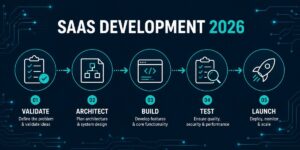
Step 1. Validate Before You Build Anything
Most SaaS products fail before launch. Not because of bad code. Because nobody validated whether the market actually wanted the product.
One founder I know spent nine months building a compliance tool for mid-size law firms. He talked to exactly zero lawyers during development. Turns out those firms had workflows they had used for years and had zero interest in switching. The product launched in silence.
Validation means talking to real potential users. Understanding what they do today and where it breaks. Confirming the problem is painful enough that they would pay to solve it. This phase should happen before a single line of code gets written.
Step 2. Architecture and Requirements
This phase defines what the product does technically and how it is structured. Multi-tenant or single-tenant. Microservices or monolith. Which compliance standards apply? GDPR. HIPAA. SOC 2. Which third-party integrations does the product need to support from day one?
Get this wrong, and you will spend money rebuilding it the moment you try to scale. I have watched that happen to multiple products. It is painful every time.
For most SaaS products with complex backend logic, Laravel remains one of the strongest frameworks available in 2026. The structure it enforces prevents a significant amount of technical debt down the line.
Step 3. MVP Development
Build the core. Ship it. Learn from real users.
No-code platforms like Bubble and Webflow can take a product from idea to first paying customer. Some businesses have reached $1M ARR on no-code before using that revenue to fund a proper custom build. That is a smart way to reduce risk early.
For production-ready SaaS that needs to handle serious scale, the infrastructure needs to be right from the start. Cloud-native deployment on AWS or GCP. Clean API design. Security and compliance baked in, not bolted on later.
Step 4. QA and Testing
This is the step teams rush. It is also the step that kills user trust fastest when it goes wrong.
Automated testing catches issues before users see them. It also compresses deployment cycles because the team stops manually checking every release. Our QA testing and automation process treats this as a core deliverable on every project, not something that happens at the end if time allows.
A SaaS product that breaks in production loses users. They do not give second chances.
Step 5. Launch, Measure, Improve
Launch is not the finish line. It is when the real learning starts.
Real users behave in ways no product team ever fully predicts. The features you spent the most time on may sit untouched. The secondary workflow you almost cut becomes the primary reason users stay. The feedback loop between users and the development team is what separates products that grow from products that stall.
SaaS Technology Stack in 2026
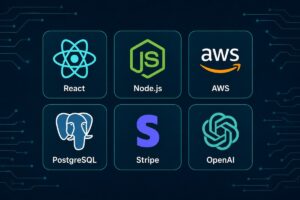
The right SaaS development framework depends on what you are building and how fast you expect to scale. Here is what experienced teams are working with right now.
| Layer | Tool | Why It Works |
| Frontend | React.js or Next.js | Fast, scalable, component-based |
| Backend | Node.js, Python, or Laravel | Depends on product complexity |
| Database | PostgreSQL via Supabase | Reliable and integrates cleanly |
| AI | OpenAI or Anthropic API | Core intelligence layer |
| Vector Search | Pinecone | AI-powered search and retrieval |
| Auth | Auth0 or Clerk | Multi-tenant authentication |
| Billing | Stripe | Standard for SaaS monetization |
| Infrastructure | AWS, GCP, or Azure | Cloud-native from day one |
For AI-heavy products, understanding generative AI and what it means for your product roadmap is worth reading before you finalize any architectural decisions.
Real SaaS Products Worth Studying
Shopify picked one vertical. E-commerce. Not project management, not HR tools, not CRM. Just one specific user with one specific problem. Today it powers over 4 million stores globally and commands premium pricing because it goes deeper than any horizontal competitor can.
Zoom launched as video conferencing and almost nothing else. Every major product addition since came from watching what users were actually doing inside the product. Not from a roadmap. From behavior data.
HubSpot built a CRM that connected marketing, sales, and customer service into one system. It started with small businesses, learned their workflows deeply, and expanded from there. The depth of domain knowledge built into the product is what makes it hard to replace.
All three followed the same pattern. Narrow focus. Real validation. Continuous iteration based on actual user behavior.

Why Vertical SaaS Wins in 2026
Horizontal SaaS tries to serve every industry. Vertical SaaS serves one deeply.
A logistics company using a generic project tool is leaving money on the table. A logistics company using SaaS built specifically for route planning, driver compliance, and dispatch coordination is operating at a completely different level. The AI in a vertical product can be trained on industry-specific data. That makes it dramatically more useful than a general model.
Vertical SaaS also builds stickier customers. When your software understands the specific language, regulations, and workflows of a single industry, switching to a generic alternative feels like a downgrade. That is pricing power. That is retention. That is the business case for going niche.
Conclusion
Software that was built for everyone usually works well for nobody specifically.
The businesses doing well with SaaS in 2026 are not necessarily better funded or bigger. They validated early. They built tight. They iterated fast. They used AI from the architecture stage, not as an afterthought.
If you are thinking about what custom SaaS development could look like for your business, talk to the QM Logics team. We have built products across industries, and we know what separates the ones that grow from the ones that stall.
Frequently Asked Questions
What is the difference between SaaS development and regular software development?
Regular software gets built once and installed on devices. Updates happen infrequently. SaaS products live in the cloud, get updated continuously, and serve many users simultaneously. The architecture is fundamentally different. So is the business model. SaaS runs on subscriptions, which means the product has to keep earning that payment every single month.
How long does it take to build a SaaS product from scratch?
A tight MVP with a clear scope takes 2 to 3 months with an experienced team. A full platform with AI integration, compliance requirements, and multi-tenant architecture typically runs 3 to 6 months from discovery to launch. Most delays start in the discovery phase when requirements are not properly defined before development begins.
What is the best SaaS development framework in 2026?
There is no single answer. React with Node.js or Laravel covers most SaaS products well. For AI-heavy products, the AI layer needs to be part of the architecture from the start, not added later. The best framework is whichever one the development team knows deeply and which fits the product’s specific technical requirements.
How do I find the right SaaS development company?
Look for teams that have shipped real products in production. Ask specifically about their discovery process, architecture approach, and QA practices. A team that cannot explain how they handle scope changes mid-project is a red flag. Client references matter more than portfolio screenshots.
What makes custom SaaS development worth it over buying existing software?
When your workflow does not fit any existing tool cleanly. When you are paying multiple subscriptions for tools that do not integrate. When a competitor has the same software you do, and you are looking for a way to differentiate. Custom SaaS gives you software built around your specific process, owned by you, that nobody else can replicate.