 Web Development
 APP Development
 CRM Development
 Digital Transformation
 Generative AI
 QA Testing & Automation
Okay, so you’ve read three or four of these “what is MERN stack” posts already, and closed most of them halfway through. Fair. Most of them are the same five paragraphs with different filler around them.
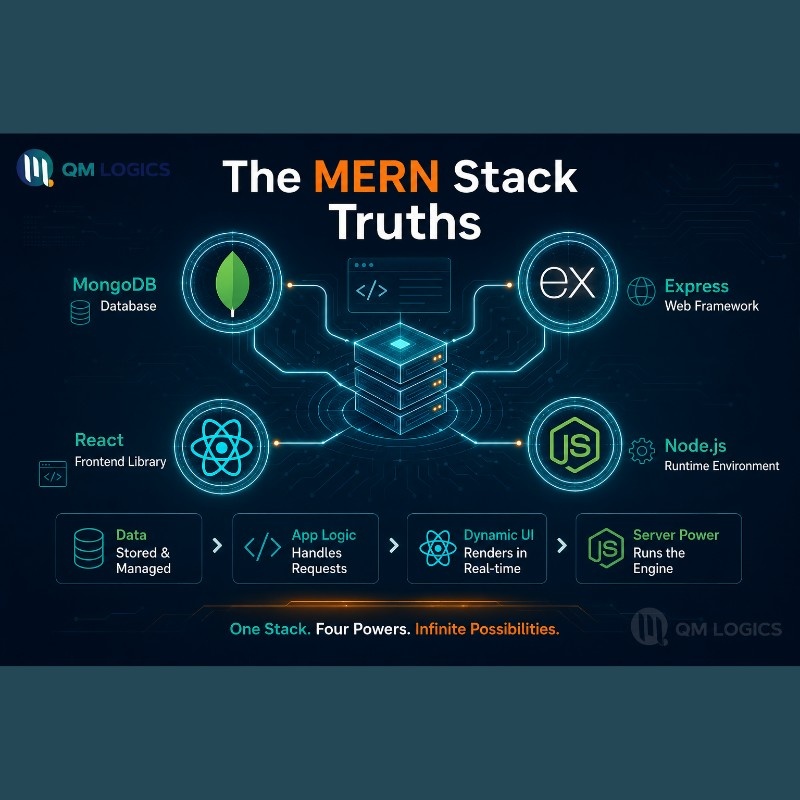
Here’s what it actually is, no fluff. MERN means you build your whole app- frontend, backend, database- in one language. JavaScript, top to bottom. MongoDB stores the data. Express runs the server logic. React is the part users actually see and click on. Node is what lets JavaScript run outside a browser, on a server, in the first place.
Four pieces. One language. No translator sitting between your frontend guy and your backend guy.
I’ve sat through enough client calls now to know what actually matters here isn’t the tech list; it’s the team size question. When someone tells me they need to launch in six weeks with two developers, I don’t ask about budget first. I ask if one small team can own the whole thing start to finish. With MERN, usually the answer is yes.
What MERN Actually Means (Not the Textbook Version)
Everyone explains MERN stack meaning the same lazy way: “it’s four technologies.” Cool, but that’s not why it works. It works because there’s almost no friction between the pieces.
MongoDB doesn’t make you cram data into rigid tables like a spreadsheet. It stores things as documents, kind of like JSON, which happens to be exactly the shape your React frontend already understands. So data doesn’t need to get reshaped five times on its way from the database to the screen.
Express sits on Node and handles the routing, basically deciding what happens when a request comes in. Node itself is just the engine underneath, the thing that lets your JavaScript actually run on a server instead of only in Chrome.
How the Pieces Talk to Each Other
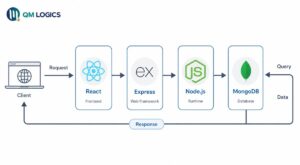
Say a user clicks “load dashboard.” React fires off the request. Express catches it, figures out what’s being asked. Node is running that whole process. MongoDB grabs the matching records and sends them back.
No language switch anywhere in that chain. A React developer can usually poke around the Node backend without needing a translator. Small thing, sure, but it adds up fast when your team is three people, not thirty.
Why People Actually Choose MERN Stack Web Development
Everyone says “it’s fast.” True, but that’s half the answer.
React components get reused constantly; build a card layout once, drop it in fifteen places. MongoDB’s schema bends when your data model changes mid-project, and it always changes mid-project; nobody nails the data structure on the first try. React also happens to be the most-used frontend library among working developers right now, which just makes hiring easier than chasing down someone who specializes in, I don’t know, a framework three people at your company have heard of.
There’s a concurrency angle too that people skip over. Node handles a lot of simultaneous connections without falling over, which is exactly why chat tools, live dashboards, and notification systems keep landing here instead of on something heavier.
None of this means MERN fits everything. A five-page brochure site doesn’t need any of it; honestly, overkill. But the second your app needs real accounts, live data, or actual interactivity, the math shifts.
A Pattern I’ve Watched Play Out More Than Once
Two developers. Eight weeks. A founder who needs something that actually works, not just looks nice in a Loom demo.
They build the dashboard UI in React. Session handling runs through Express middleware. The usage events, which change shape every time the product decides to track one more metric, sit in MongoDB collections that don’t need a migration script every time someone changes their mind on Tuesday.
Same story shows up in e-commerce for inventory and recommendations, in healthcare portals for patient records, in fintech for fraud dashboards. Different industries, same reason underneath: the stack flexes without breaking when requirements shift. And they always shift.
MEAN vs MERN, Since Everyone Asks
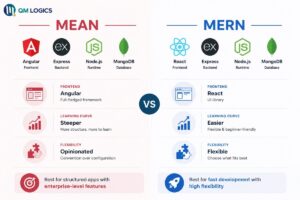
Three of four letters are identical; MongoDB, Express, Node stay the same in both. The entire argument comes down to one thing: Angular or React on the frontend.
Angular is opinionated. Routing, forms, state, all baked in. Great if your team wants guardrails on a big long-term build. React gives you way less structure out of the box, which sounds bad until you realize that’s exactly what makes it quicker to prototype with.
Numbers back it up, too: roughly 40% of developers use React day-to-day versus about 23% for Angular (QM Logics). That gap matters when you’re staffing a team on a deadline, not just picking a framework because it sounds fun.
| What you’re weighing | MERN (React) | MEAN (Angular) |
| Getting started | Fast, plain JS | Slower, TypeScript required |
| Best fit | Startups, MVPs, fast builds | Big structured enterprise systems |
| How it feels to use | Snappy, virtual DOM | Heavier but optimized |
| Finding developers | Easier | Smaller pool |
| Flexibility | High | The framework enforces its rules |
Need something live in weeks, MERN usually wins. Building an internal enterprise tool with fifteen developers who all want strict conventions, MEAN might genuinely be smarter. Neither one wins outright. They just solve different problems.
Hosting a MERN App Without Overthinking It
There’s no single best hosting for MERN stack apps; people search for that phrase like there’s one right answer. There isn’t. There’s a right setup for your traffic and your budget, and it changes as you grow.
Small app or MVP, Render or Railway with MongoDB Atlas gets you live in an afternoon. Atlas has a free cluster that’s genuinely fine for testing and small production loads; you only pay once you outgrow it. Vercel is great for the React frontend specifically but won’t run your full Express backend, so most teams pair it with a separate Node host for the API side.
When You Actually Need AWS
AWS MERN stack setups start making sense once you’ve outgrown the “deploy and forget” tier. Already living inside AWS, Amplify connects cleanly to Lambda, DynamoDB, Cognito for auth.
Want more manual control? EC2 or Elastic Beanstalk gives you a fully configurable Node environment.
A common production layout: React build files on S3 plus CloudFront, Express API on Elastic Beanstalk or EC2, MongoDB managed separately through Atlas instead of sitting on the same box as your app server. Mixing those two on one instance is basically how you end up debugging a database outage at 2 am for no reason.
What a Real MERN Development Company Should Show You
A serious MERN stack development company shows you finished, working products. Not a logo wall. Not a stack list on the homepage that says nothing. Ask how they handle auth, rate limiting on the API, indexing in MongoDB. Three questions, and you’ll learn more than any portfolio page tells you.
At QM Logics, this is how our team approaches MERN stack development services for clients across the US. Architecture, Node.js development, and React.js development under one roof, so you’re not stuck between two vendors pointing fingers at each other when something breaks. Our web development page walks through how we scope things before a single line of code gets written.
A Fit Test You Won’t Find on Other MERN Guides
Most articles say “MERN is great for startups” and stop there. Not specific enough to actually decide anything. So here’s the five-question test I run internally before recommending a stack to anyone. Be honest with yourself on these.
- Will your data structure probably change in the next six months? If yes, MongoDB’s flexibility isn’t a nice-to-have; it’s the whole point.
- Does your team need to move fast without much headcount? One-language stacks cut down the back-and-forth between frontend and backend people.
- Do you need live features, chat, notifications, dashboards that update on their own? Node handles that noticeably better than a lot of the alternatives.
- Is this a long-lived enterprise system with a big, structured team already in place? If so, don’t force MERN on it just because it’s the popular answer this year; MEAN might actually serve you better.
- Are you optimizing for hiring speed down the road? React’s talent pool is big, and that matters more once you’re past your founding team.
Three or more yeses on the first three questions, MERN is very likely the right call. Question four hits hard; that’s worth an actual conversation before you commit to anything.
P.S. If your phone has been exposed to water, this step-by-step water damage guide walks through what to do in the first 30 minutes.
Handoff Mistakes Nobody Writes About
This part barely shows up anywhere else, and it should. When a client brings us a struggling MERN app, the problem is almost never the stack. It’s how it got built.

Most common issue: no indexing on MongoDB collections that get hammered with queries constantly. Works fine with test data, falls apart the second real users show up. Right behind that, API routes with zero rate limiting, which turns into a security and cost headache the first time something scrapes the site overnight. Third one, React state that grew without any real plan, so every new feature takes longer to ship than the last one did.
None of that is a MERN problem. It’s a planning problem that happens to live inside a MERN app. Worth knowing before you blame the framework for something the build process caused.
MERN Stack Roadmap for 2026
Building skill yourself, or checking a candidate’s depth, here’s the order that actually makes sense.
JavaScript fundamentals first, always. Skipping straight to React never ends well; I’ve watched people try.
React basics: components, props, state, hooks, the layer users actually see.
Node and Express come next: routing, middleware, REST APIs, the connective tissue holding it together.
MongoDB and Mongoose after that; schema thinking matters more than syntax memorization.
Auth and deployment last: JWTs, environment variables, getting something actually live instead of stuck on localhost forever.
A structured MERN stack course shortcuts a lot of the trial and error here. Evaluating someone else instead of learning it yourself, this same order tells you exactly what to ask about in an interview.
Conclusion
MERN stack development isn’t a trend you need to chase because everyone else is. It’s a practical answer to a real problem: build fast, hire without pulling your hair out, and don’t box yourself into a corner when requirements change. Weighing MEAN against MERN, picking hosting, trying to hire the right person, the fit test above will get you further than another generic comparison post.
Still not sure? Talk to someone who’ll tell you honestly whether MERN fits what you’re building, not just whoever answered the phone first.
Frequently Asked Questions
Is MERN stack still worth learning in 2026?
Yes, not even close. Thousands of production apps run on it, and the flexibility argument gets stronger, not weaker, as products keep evolving.
Is MERN frontend or backend?
Both. React covers the frontend. Express and Node handle the backend. MongoDB sits underneath, storing everything.
How long does a MERN build actually take?
Simple app, two to four weeks. Something feature-heavy with a bunch of integrations, three to six months. Depends entirely on scope; nobody can give you a real number without knowing what you’re building.
Do I need to learn MEAN too?
Not really. MongoDB, Express, Node overlap completely between the two. Moving from MERN to MEAN later mostly just means picking up Angular.
What’s MERN actually best suited for?
SaaS dashboards, e-commerce, real-time apps, anything where the interface needs to feel quick and the data model needs room to shift around.