 Web Development
 APP Development
 CRM Development
 Digital Transformation
 Generative AI
 QA Testing & Automation
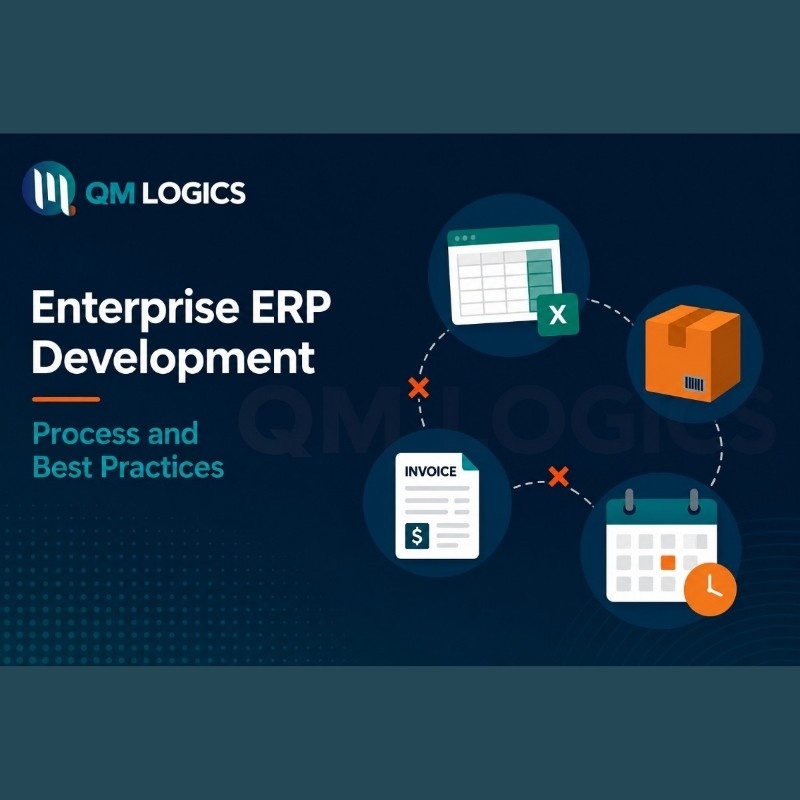
Every growing business hits the same wall eventually. Spreadsheets stop talking to each other. Inventory numbers in one system disagree with sales numbers in another. Someone on the finance team is manually re-entering data that already exists somewhere else. ERP development solves this exact problem by building one connected system that replaces a dozen disconnected tools.
QM Logics has sat in enough discovery calls to know that most business owners do not wake up wanting an ERP. They wake up tired of chasing numbers across five different apps. That frustration is where real ERP development conversations start, and it is why the demand for ERP development company partners has grown so quickly across the United States over the past two years.
In this guide, I will walk through what ERP development actually involves, the best framework for ERP development in 2026, how a proper ERP development process runs from the first meeting to go live, and how to hire ERP developers who will not disappear halfway through your project. I am writing this from direct experience building ERP systems at QM Logics, not from a textbook.
What Is ERP Development and Why It Matters Right Now
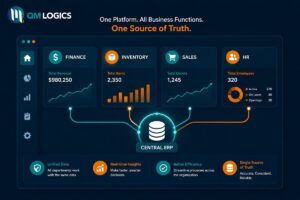
ERP(Enterprise Resource Planning) development is the process of designing, building, and deploying software that unifies core business functions such as finance, inventory, sales, procurement, and HR into a single connected platform. Instead of five tools that barely sync, you get one system that reflects what is actually happening in your business in real time.
Market data backs up why this conversation has picked up so much urgency. Recent industry research from Grand View Research pegs the global ERP software market at well over 90 billion dollars in 2025, with continued double-digit growth through 2026 as more mid-sized companies move away from spreadsheets and disconnected tools. Cloud ERP adoption has climbed past 70% of new deployments, a clear signal that businesses want systems they can scale without a server room.
For a company evaluating ERP development services, this growth matters because it means the tooling, hosting, and integration options available today are far more mature than they were even three years ago. You are no longer choosing between clunky old software and a 5-year build. Custom ERP development today can move faster and cost less to maintain than most business owners expect.
Custom ERP Development vs Off-the-Shelf ERP Software
This is the question I get asked in almost every first call: Should we build custom or buy something ready-made? Both paths are valid, and the right answer depends on how unusual your workflows actually are.
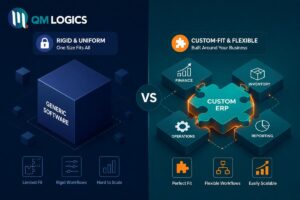
Off-the-shelf platforms like NetSuite or standard Odoo installs work well when your processes look like everyone else’s in your industry. Custom ERP development earns its keep when your business runs on workflows that generic software simply was not built to handle, things like multi-location inventory rules, unusual approval chains, or industry-specific compliance steps.
| Factor | Off-the-Shelf ERP | Custom ERP Development |
| Setup speed | Faster, often weeks | Longer, needs a build cycle |
| Fit to your workflow | Generic, may need workarounds | Built around your exact process |
| Long-term flexibility | Limited by vendor roadmap | Fully yours to extend |
| Ownership | Rented, subscription-based | You own the codebase |
| Best for | Standard operations, smaller teams | Unique operations, scaling businesses |
Signs Your Business Needs Custom ERP Development
A few patterns show up again and again in companies that end up choosing custom ERP development over an off-the-shelf license:
- Your team has built a maze of spreadsheet workarounds just to make an existing tool function
- You operate across multiple warehouses, branches, or entities with different rules
- Your reporting needs go beyond what dashboard filters in a generic tool can produce
- You are paying for modules in your current software that you never use
- Your growth plans include features no vendor roadmap currently supports
I worked with a client in logistics last year whose team was manually reconciling delivery data between three tools every single day. Once we mapped their actual workflow, it became clear no off-the-shelf platform matched it closely enough to be worth forcing. A custom build solved in one system what three tools never could together.
Best Framework for ERP Development in 2026
Picking the right framework shapes everything that follows, from hiring to long-term maintenance costs. Here is how the leading options actually compare for real-world ERP app development work.
Odoo remains the most widely adopted open source framework for ERP development, and for good reason. Odoo ERP software development runs on Python at its core, paired with PostgreSQL for data and its own OWL JavaScript library for the interface. It ships with dozens of official apps covering CRM, accounting, inventory, and manufacturing, plus a large community of third-party modules. Odoo ERP development services scale well for small and mid-market companies that want a modular system they can expand app by app.
ERPNext, built on the Frappe framework, is another strong open source option. It also runs on Python with a JavaScript frontend and tends to suit smaller teams that want a low-code environment for customization.
Microsoft Dynamics 365 runs on C# and .NET, a solid choice for companies already embedded in the Microsoft ecosystem.
SAP, still the largest ERP vendor by market share, relies on its own ABAP language and generally fits large enterprises with complex global operations and bigger implementation teams.
So what is the best language for ERP development? There is no single universal answer, but Python shows up constantly across the most popular platforms, Odoo and ERPNext both included, because of its readability, its strong library ecosystem, and how quickly developers can extend it without fighting the framework. For most mid-sized US businesses evaluating custom ERP development, Python-based frameworks offer the best balance of flexibility, community support, and long-term maintainability.
ERP Development Tools Worth Knowing About
Beyond the core framework, a few categories of ERP development tools shape how smoothly a build actually goes:
- Version control and CI/CD pipelines to keep custom modules stable across updates
- API and integration layers such as REST or XML-RPC to connect with existing software
- Reporting engines like QWeb for generating invoices, statements, and business reports
- Testing frameworks to catch issues in custom modules before they reach production
- Cloud hosting environments built for elastic scaling as your data grows
The ERP Development Process We Follow at QM Logics
A reliable ERP development company should never start writing code on day one. Here is the process that consistently produces systems clients actually want to use.
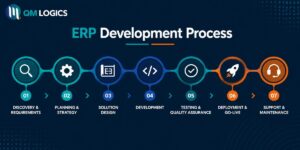
- Discovery and mapping. We sit down with the people actually using the current workflow, not just leadership, and map every step that data takes through the business today.
- Framework and architecture selection. Based on the discovery findings, we recommend the right framework, whether that means Odoo ERP development services, a fully custom build, or a hybrid approach.
- Module design and prototyping. We design the core modules around your real workflow before writing production code, so revisions happen on paper, not after launch.
- Development and integration. This is where ERP development and integration solutions converge, connecting the new system to your existing tools, such as payment processors, shipping platforms, and CRMs.
- Testing and quality assurance. Every module gets tested against real business scenarios, not just sample data.
- Deployment and training. Go live happens in phases where possible, with hands-on training so your team is not left guessing.
- Ongoing support. ERP systems are never really finished. Business rules change, and the system needs to change with them.
Client Feedback: One of our manufacturing clients described the difference this process made in a way that stuck with me. Their operations lead told our team that for the first time, “the numbers on the floor and the numbers in the office finally matched.” That kind of feedback is exactly why the discovery phase matters more than the code itself.
Common ERP Development Mistakes to Avoid
- Skipping the discovery phase and jumping straight into development
- Choosing a framework based on trends instead of your actual workflow needs
- Underestimating the training your team needs after launch
- Treating integration as an afterthought instead of a core requirement
- Building every feature at once instead of launching core modules first
How to Hire ERP Developers Who Understand Your Business
If you are trying to hire ERP developers, technical skill is only half the equation. I have seen technically excellent developers build a system that nobody in the business actually wanted to use, because they never understood the workflow behind the code.
Look for a team or an ERP development company in USA (i.e., QM Logics) that asks about your business processes before mentioning frameworks. Ask to see how a past project handled a workflow similar to yours. Ask what happens after launch, because ongoing support separates a usable ERP from an abandoned one within a year.
QM Logics builds custom ERP development projects around this exact philosophy for mostly USA clients, treating the business process as the starting point and the code as the tool that serves it, not the other way around.
ERP Core Modules Explained
For anyone newer to this space, ERP – stands for Enterprise Resource Planning. In plain terms, it means one software system that plans and manages the resources across your entire business rather than leaving each department to run its own disconnected tool.
Most ERP systems, whether bought off the shelf or custom-built, are made up of a similar core set of modules:
- Finance and accounting
- Inventory and warehouse management
- Sales and customer relationship management
- Procurement and vendor management
- Human resources
- Reporting and business intelligence
Custom ERP development lets you decide which of these modules you actually need on day one, instead of paying for a bloated system built around modules you will never touch.
Conclusion
ERP development is not about buying software. It is about giving your business one accurate source of truth instead of five competing versions of the same data. Whether that means custom ERP development built from scratch or a well-configured Odoo ERP development services deployment, the right choice always comes back to how closely the system matches the way your team actually works.
If your business has outgrown spreadsheets and disconnected tools, QM Logics can walk you through what a custom ERP development project would look like for your operations. Feel free to explore our software development services or request a quote to start the conversation.
Frequently Asked Questions
How long does custom ERP development usually take?
Timelines vary by scope, but a mid-sized custom ERP build typically moves through discovery, development, and testing over several months rather than weeks. Off-the-shelf platforms deploy faster because the core modules already exist.
Is Odoo good for ERP development?
Yes. Odoo ERP software development is widely used because of its modular structure, Python foundation, and large ecosystem of community and official apps, making it a strong starting point for many mid-market ERP projects.
Can an ERP system integrate with software I already use?
This is one of the main reasons businesses choose ERP development and integration solutions over a standalone tool. A properly built ERP connects to your existing payment processors, shipping tools, and CRMs through APIs instead of replacing everything at once.
Do I need a developer team or can I use a template?
Templates work for very standard operations. The moment your workflow includes anything unusual, a dedicated ERP development company will save you far more time than trying to force a template to fit.
What industries benefit most from custom ERP development?
Manufacturing, logistics, distribution, and healthcare consistently show up as industries where custom ERP development outperforms generic software, mainly because their operational rules rarely match a one-size-fits-all system.